Greensite… on mayoral endorsement… Steinbruner… lithium battery fires… big PG&E project… Hayes… California Oatgrass… Patton… Whose House?… Matlock… shadow docket…purges…slopaganda… Eagan… Subconscious Comics and Deep Cover … Webmistress serves you… Sammy Obeid… Quotes on… “Comedy”

|

I’LL BE BRIEF THIS WEEK. I feel like I’m getting back into the swing of things, and the days are getting shorter and shorter. According to “everyone”, we are going to have a record El Niño this year. I vividly remember the one back in 1997, so that’s a scary concept. Back then, we lived in a house that had a goldfish pond in the back yard, and it rained so much that the pond overflowed and the goldfish were swimming all over the lawn! We scooped them up in buckets…
~Webmistress
MONSTER MOVIE ORIGINS 
IT’S SPOOKY SEASON! Let’s step back from the Universal canon: Karloff, Lugosi, Chaney Jr., and company. Go back just a couple of decades and you’ll find essentially the same lineup, only quieter.
As a kid in the early ’70s, I devoured movie history books, falling in love with films I’d never actually seen. They certainly weren’t showing up on TV. For years I assumed Edison’s “Frankenstein” existed only as that one tantalizing photograph in the history books.
Then came the internet, and suddenly I could watch a film I’d wanted to see since childhood. A hole in my heart I hadn’t even realized was there had finally been filled.
And there’s the original “Nosferatu”, an unauthorized adaptation of Bram Stoker’s “Dracula”. Stoker’s estate sued and won an order to destroy the film. Fortunately, prints had already circulated abroad, or we’d have lost this masterpiece entirely.
So here’s the original monster lineup, before Universal made them household names:
- Frankenstein
- J. Searle Dawley’s “Frankenstein” (1910), produced by Edison. [Watch]
- Dracula
- F. W. Murnau’s “Nosferatu” (1922). [Watch]
- Wolf(wo)Man
- Henry MacRae’s “The Werewolf” (1913), written by Ruth Ann Baldwin. Sadly, a lost film.
- The Mummy
- Georges Méliès’s “Le Monstre” (1903). [Watch]
- Dr. Jekyll and Mr. Hyde
- John S. Robertson’s “Dr. Jekyll and Mr. Hyde” (1920), starring John Barrymore. [Watch]
- The Phantom of the Opera
- Rupert Julian’s “The Phantom of the Opera” (1925), starring Lon Chaney. [Watch]
- The Hunchback of Notre Dame
- Wallace Worsley’s “The Hunchback of Notre Dame” (1923), also starring Chaney. [Watch]
YouTube is a treasure trove of early cinema. If you’re inclined to explore the roots of spooky movies, there’s also *Häxan* (1922), *Metropolis* (1927), *Vampyr* (1932), and plenty more.
They’re not just historical curiosities. They’re worth watching.
~Sarge

STEPHEN KING: A NECESSARY EVIL. Prime Video, Magellan TV. Movie. (7 IMDb)
Stephen King: A Necessary Evil – welcome to Spooky Season!
“Quadriplegic … unwed mother … telekinesis… waffle hut… and drat, aliens again” – Stephen King with his plotting dartboard.
Stephen King is one of those authors whom I enjoy as a person, but who makes my teeth itch as a writer. Which is why I really enjoyed “Stephen King: A Necessary Evil”- all about King and how/why he thinks about things. Behind the mind of the Shining, Misery, IT!, Stand By Me, the Green Mile, Shawshank Redemption, etc. Not spooky at all, except in just how much he has written (over 200 short stories alone), and impacted readers around the world for the last 5 decades. Fully worth a watch (and no surprise aliens at the end)
~Sarge
PRACTICAL MAGIC 2. In theatres. Movie. (6.3 IMDb) 
Practical Magic 2: Magical Boogaloo… The romantically cursed Owens sisters are back, along with the principal cast: Sandra Bullock, Nicole Kidman, Stockard Channing, and Dianne Wiest. Joining them are Joey King and Maisie Williams as Sally’s daughters, who have inherited both the family gift and its rather unfortunate fine print.
The basic premise, for those who missed the original: an Owens ancestor, determined to protect herself from the heartbreak of love, cast a curse that has plagued the family for generations. Any man who falls in love with an Owens woman dies. This time around, it’s the younger generation’s turn to deal with the problem.
Unfortunately, the story has been so drastically truncated from Alice Hoffman’s novel (The Book of Magic) that both the plot and the characters suffer. Maisie Williams, in particular, is completely wasted. It’s fun to see everyone together again, but the whole thing feels fragmented, as though large chunks of the story were left on the cutting-room floor.
A pleasant bit of fluff if you’ve got the time. Otherwise, wait for the streaming release. Worth a casual watch, but hardly worth a trip to the theater.
~Sarge
OBSESSION. Peacock. Movie. (7.8 IMDb) 
Obsession is less a “be careful what you wish for” story than a warning to be careful what someone else wishes about you. What begins as desire curdles into something far more complicated, until it becomes difficult to tell who is really the villain and who is simply the victim of a wish that has gone badly wrong. The result is a modest but effective little story about longing, control, and the danger of getting exactly what someone thinks they want. Definitely worth a watch.
~Sarge
KATLA. Netflix. Movie. (7 IMDb)
Katla is bleak in the best possible way, set beneath the ash-gray skies of a small Icelandic town, Vik, where everyone seems to have learned to survive by saying as little as possible. But when the volcano begins returning people who should not be there, it does more than produce doppelgangers; it drags old grief, guilt, resentment, and buried secrets out of lives already worn thin. What begins as a supernatural mystery gradually becomes something more unsettling, asking whether identity is really a matter of being the “original,” or whether the person who loves more deeply, suffers less damage, or makes better choices might have the stronger claim to that life. Quiet, strange, and relentlessly melancholy, Katla makes its frozen landscape feel like an extension of the people living in it: apparently still, but with something hot and dangerous moving underneath. Worth a watch.
~Sarge
THE LAST HOUSE. Netflix. Movie. (5.5 IMDb) 
Buñuel’s The Exterminating Angel meets Lovecraft.
This is the ultimate “bottle story.” A suburban Seattle family wakes up one morning to find they can’t leave their house – and neither can anyone else on the block, or maybe anywhere. Some kind of mostly unseen force has sealed everyone in, and it brings the rain with it. Endless, relentless rain.
Stories like this always get under my skin. There’s a very specific kind of tension that kicks in once it starts to feel like there’s no way out – I stop hoping for a clever escape and start just wanting these poor people put out of their misery. That’s not a knock on the film; it’s a testament to how well it builds dread. You feel the walls closing in right along with the family.
What makes it work is the slow unraveling – watching ordinary people get inventive out of sheer necessity, rationing food, rigging up ways to collect water, turning on each other and then back to each other again. It’s as much a study in psychological survival as physical survival. The monster stuff, when it finally shows up, feels almost like an afterthought bolted onto a much stranger, much better film about isolation and endurance – but even that tacked-on quality has a certain charm, like the movie couldn’t resist giving its dread a shape.
Worth a watch.
~Sarge
|
Sarge, aka Jeffery Sargent, cut his teeth on the Golden Age of Hollywoood on TV and with regular trips to the Sash Mill. Film classes then, at Cabrillo with Morton Marcus, broadened his scope – he found he preferred Keaton over Chaplin, and Akira Kurosawa was his Yoda. Sarge spent 15 years working in Special Effects, on everything from Starship Troopers to Battlestar Galactica. He is a staunch geek who has a weak spot for Cozy Mysteries and loathes “Reality” shows. While he doesn’t care for the unrelenting banal horror of “True Crime”, he licks his lips over a twist like the end of Chinatown. Email Sarge at JeffLSargent@gmail.com |
October 5, 2026
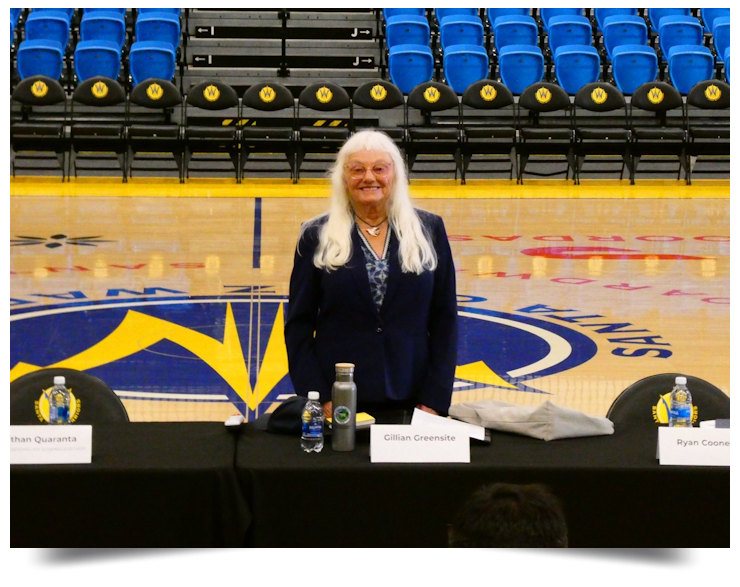
Photo from Chamber of Commerce Forum May 14, 2026
By now you probably know that I am endorsing Ryan Coonerty for mayor. This decision was made after careful analysis of where both candidates stand on my campaign issues. I sought input from people whose judgment and objectivity I trust. The reactions to this news reveal a lot about the people delivering their opinions.
On the outraged side, comments include, “Her act of endorsing Ryan is a kick in the teeth to everyone in the progressive community” and “Gillian’s endorsement is a complete slap upside the head” and “This time it is Gillian as the executioner.” On the deeply disappointed side were fears that I had been taken in by flattery or maybe offered a paid job (not true, for the record), that I should withdraw my endorsement or refrain from voting. There also were those who were civil in their disagreement with my decision. I’m a free-speech absolutist and civility always beats hostility if you want to get your point across. Hostility is like spitting upwind. As Desmond Tutu said, “don’t raise your voice, improve your argument.”
I sent an email to all the people who contributed to my campaign with a full explanation for my endorsement decision. Those who chose to reply were overwhelmingly positive and supportive of that decision. Those progressives who react with indignant self-righteousness or anger should understand they do not represent the whole progressive community.
I ran an independent campaign on the issues. My central issue was a critique of the city’s endorsement of overbuilding, an issue I supported with data and evidence. Over the course of fourteen campaign forums, I listened carefully to what each candidate was saying and whether they were communicating realistic goals or feel-good, unachievable slogans. I also read their posted positions, particularly on issues of housing development.
With the primary election over and the results determined, the focus is now on the two competing candidates. I see clear differences between the two on significant issues raised in my campaign. On her website, Ami Chen Mills writes, “I support rezoning for increased multi-family housing and condos in our neighborhoods.” I strongly oppose that position as does candidate Coonerty. Under state housing laws, it would not be an alternative to the big projects but in addition to them.
State housing law already allows 8 units on single-family lots (4 houses and 4 ADU’s) so to increase that density with the YIMBY (Yes In My Back Yard) policy they call “the missing middle” is to allow multi-story, multiple-family projects in our neighborhoods which will radically increase traffic, parking and all the impacts that come with increased density. I notice this campaign policy of Ami’s is missing from her direct mailer that I just received in my mailbox.
Ami’s stated priority that “new developments must fit neighborhoods and serve local people” sounds great but it’s little more than a feel-good slogan without a candidate having significant electoral experience, established state contacts, deep knowledge of state and local housing policy, trust of management staff and other council members. With all due respects, Ami is lacking in these areas (as am I, except for the local preference policy part). This knowledge and connections comprise Ryan Coonerty’s strength.
Ryan has made it publicly clear that the data and evidence I shared during the primary campaign helped him reassess his assumptions around housing development; to recognize that the city is moving too quickly. He is against the Overlay district that would get rid of public hearings and has shared specifics on how to slow things down. This commitment coincides with a welcome shift at the state level with a Resolution passed at the League of CA Cities to have a state-wide effort to take back local control over land use decisions.
I respect Ami Chen Mills, I did not refuse a request to meet (as some have falsely accused), I am not a pushover for empty promises, and I never agreed to be part of a slate opposing Ryan Coonerty. I ran an independent campaign on the issues; I evaluated each candidate carefully, consulted with others and from that perspective decided to endorse Ryan Coonerty. That is my choice and I’m sure you will make yours.
| Gillian Greensite is a long time local activist, a member of Save Our Big Trees and the Santa Cruz chapter of IDA, International Dark Sky Association http://darksky.org Plus she’s an avid ocean swimmer, hiker and lover of all things wild. |
This Friday, Monterey County Ag Commissioner will be my Guest on “Community Matters” on KSCO at 2pm-3pm. Listen in and find out what Monterey County officials are doing to monitor for any contaminants associated with the Vistra Battery Fire that occurred on September 18. What did this agency do differently this time to protect the health and safety of the farmworkers in fields where the smoke plume traveled?
What is the Action Plan for the next fire? Vistra acknowledges that fires are likely as the clean up work continues, expected to be complete by the middle of next year.
Listen in on KSCO Radio AM 1080, FM 104.1, or online streaming: ksco.com
The program will be recorded and posted on the Station webpage.
HOW TO AVOID LITHIUM BATTERY FIRES IN YOUR HOME
This Friday, Scotts Valley Fire and Central Fire Marshal Erin Collins and Firefighter Kevin Laine will be my Gusts on “Bratton on KSCO” at 6pm-7pm. Listen in and learn from these experts what they have observed and experienced with lithium battery fires and what you can do to avoid them.
October 4-11 is National Fire Prevention Week. This year’s theme is Charge Into Fire Safety. Safe Charging Is a Superpower” and focuses on the everyday charging habits that can help reduce the risk of lithium-ion battery fires and keep homes and communities safer.
Listen in this Friday, 6pm-7pm on KSCO Radio AM 1080, FM 104.1, or livestream KSCO – KSCO 1080 AM, 104.1 FM News Talk Radio In Santa Cruz
IS SANTA CRUZ COUNTY LAFCO ABUSING LEGAL AUTHORITY?
The Howard Jarvis Taxpayers Association (HJTA) sent Santa Cruz Cruz County LAFCO (Local Agency Formation Commission) a letter on August 13, 2026, challenging the actions to consolidate Pajaro Valley Fire Protection District with Santa Cruz County Fire Department, which is managed and operated under contract by CalFire. The letter was not made public until the October 7 LAFCO meeting agenda.
The question is whether LAFCO is violating legal authority to add properties within the current Pajaro Valley Fire Protection District to the two assessments that Santa Cruz County Fire property owners are paying, under County Service Area (CSA) 48. One of those assessments was a Prop.. 218 Special Benefit Assessment ballot procedure in 2020. HJTA contends that the property owners in Pajaro Valley Fire District should have the ability to decide if that assessment is acceptable.
Here is a link to the HJTA letter.
At the October 7 LAFCO meeting, Mr. Serrano, Director of Santa Cruz County LAFCO, insisted this is all allowed under California Government Code 56886, having conferred with legal counsel from Best, Best & Krieger (BBK): California Government Code section 56886 (2025)
Mr. Serrano did not feel it necessary to even respond to the HJTA letter.
Mr. Don Jarvis, a Fire Consolidation expert who lives within the Pajaro Valley Fire District and formerly assisted LAFCO with the consolidation of Aptos/La Selva and Central Fire Districts, testified that he is very disappointed with the lack of financial clarity in this consolidation. He has repeatedly asked for cost analysis from the County of Santa Cruz, Pajaro Valley Fire Protection District, and LAFCO, but each time, the answer was NO. He pointed to the recent move by Pajaro Valley Fire District Boardto amend the current contract with CalFire to restore 3-person staffing on engines, and that the cost was nearly $300,000 less than what the County is claiming as basis for the assessments. “It appears that we are being overcharged just because the County can do it, and there is nothing we can do.” said Mr. Jarvis.
Two Commissioners questioned whether LAFCO could be held legally liable for any future actions related to the questions posed in the HJTA letter? Mr. Josh Nelson, the BBK counsel for LAFCO opined that he did not think so, and that he and Mr. Serrano just do not agree with the arguments raised by HJTA or members of the public who testified at the LAFCO meeting. Mr. Serrano stated that if there is any legal action down the annexation road, both the Pajaro Valley Fire Protection District and the County of Santa Cruz would be liable, not LAFCO.
Despite there being no through cost feasibility analysis performed regarding the actual cost, even though Commissioner Justin Cummings requested it, Mr. Serrano insisted that his own analysis gives property owners enough information. He did not address why the September 39 public meeting with for the property owners was cancelled, merely stating that there had already been two in May and that those were not required under law.
Ms. Kimberly Finley, Director of County General Services who oversees Santa Cruz County Fire, testified that she has been working with County Counsel, but that the County has hired an outside legal expert to advise.
Here is a link to the October 7 LAFCO meeting staff report on the issue.
PROTEST LETTERS CAUSE SUSPENSION OF PG&E PROJECT BETWEEN MORGAN HILL AND WATSONVILLE
A significant PG&E project is suspended due to a number of people who protested the CPUC Advice Letter 7982-E to increase the height of nearly 100 poles to 131′, using helicopters in construction, all without any environmental analysis or further public comment. Protesters include a Morgan Hill City Councilmember, Ms. Yvonne Martinez Beltran.
INITIAL SUSPENSION (up to 120 DAYS from the expiration of the initial review period)
This is to notify that the above-indicated AL is suspended for up to 120 days beginning
October 2, 2026(30 days after the Advice Letter filing) for the following reason(s) below. If the AL
requires a Commission resolution and the Commission’s deliberation on the resolution prepared by
Energy Division extends beyond the expiration of the initial suspension period, the advice letter will be
automatically suspended for up to 180 days beyond the initial suspension period
Stay tuned.
CALMATTERS AND SANTA CRUZ LOCAL ELECTION FORUM
Local independent reporting is critical at all times, but especially in election season when many offices and initiatives are on the November 3 ballot. People are eager for trustworthy information. I attended Tuesday’s election forum held on the outdoor patio at Santa Cruz Community Foundation and hosted by Santa Cruz Local and CalMatters. The panel discussion was moderated by Kara Meyberg, co-founder of Santa Cruz Local.
In addition to Daniel, the CalMatters representative, three Santa Cruz Local reporters spoke. It was amazing to learn that in Santa Cruz County, 87 elected seats went unchallenged or no one ran at all. Why? Ms. Meyberg announced that in the near future, Santa Cruz Local will begin hosting workshops with mentors to investigate why people are hesitant to step up to run and help promote mentors to support those who are hesitant.
CalMatters discussion focused mostly on the Insurance Commissioner seat and presented an analysis of the two candidates based on multiple issues. 2026 Voter Guide by CalMatters
You can also refer to the Santa Cruz Local Election Guide: Nov. 3, 2026 — Santa Cruz County – Santa Cruz Local
DON’T BE FOOLED BY THE MEASURE E EMPTY CAMPAIGN PROMISES
Below is an opinion letter I sent to Times Publishing, another excellent source of local information with Aptos Times, Capitola-Soquel Times and Scotts Valley Times, all free publications.
Please do not be fooled by campaign promises to make you think a new Countywide half-cent sales tax would be used to save local emergency medical care. If approved, the County would have no restrictions whatsoever on how the anticipated $27 Million would be spent. The County’s history of empty promises with two other such sales tax increases erodes any trust.
Although the problems associated with HR-1 and loss of federal funding are real for many residents in the County, half of whom live in the Pajaro Valley, a punitive regressive sales tax is no solution.
Measure E sales tax would hurt those most whom the County claims the money would be used to help, especially those in the Pajaro Valley, where the sales tax would leap to 10.25% on most items. Purchases in the unincorporated areas would be taxed at 10%.
Measure E would harm the homeless, who depend on prepared food, which is taxable. Like Watsonville, Measure E would cause a 10.25% spike in sales tax on purchases in the City of Santa Cruz and Scotts Valley. Pet food is taxable, and would further financially burden homeless with dogs for companionship and protection.
Residents throughout the County who are able will likely increase online shopping for larger purchase items, such as electronics, appliances, clothing, vitamins, books and school supplies, further harming our local businesses. Those purchasing autos, including EV’s, will likely look outside the County first.
Santa Cruz County government has great debt burden coming due in the near future due to the $80 Million unprecedented borrowing last year, just to make ends meet.
This year, the CEO recommended drawing $40 Million from reserves in order to balance the budget, bringing reserves dangerously low.
The County’s unfunded CalPERS pension liability payments for employee pensions looms large with unfunded pension liability valued at $628.7 million, and has increased $55.5 million over the past 10 years.
Despite dire economic forecasts, County Board of Supervisors approve 4% salary increases for all County employees, including middle management staff, many having annual salaries near half a million. Current SEIU contract guarantees a 3.5% salary increase next year. Supervisors evaded possible pay freezes by taking “urgency” action, rather than “emergency” action…do you see that Measure E could likely be used to fund employee salaries and pension debt?
Furthermore, Supervisors voted to make it easier to give themselves a salary increase. Is that public service leadership?
If Measure E were approved, what accountability would exist for the many non-profits likely to be funded to demonstrate actual public benefit, and not simply supporting high salaries of those CEO’s? For example,
Santa Cruz Community Health Centers | Santa Cruz, CA | Cause IQ
County CEO Coburn cautioned the Supervisors to not restrict allocation of Measure E’s anticipated $27 Million, even though Santa Cruz Mayor Keeley begged for some guarantee that a portion would be guaranteed for the City’s homeless services. This was a sly tactic to keep Measure E a broad tax to pad the County General Fund, and allow a green light upon a simple majority of the voters.
If the County were sincere in addressing the future impacts of HR-1, the sales tax would be dedicated to only that use, and would require 2/3 voter approval. In 2024, Measure N accomplished just that, to fund the Pajaro Valley Health Care District and Watsonville Hospital.
In 2018, voters approved Measure G, a “temporary” half-cent sales tax for 12 years promising “To continue funding 9-1-1 emergency response, paramedic, sheriff, fire, emergency preparedness, local street repairs, mental health services, homelessness programs, parks, economic development and other general county services” and provide approximately $5,750,000 annually, The 2021-2022 County Civil Grand Jury investigation [deemed the County’s ballot language “misleading” ]
This revenue stream will end in 2030.
In 2024, voters approved Measure K, a permanent half-cent sales tax in the unincorporated area “to fund essential Santa Cruz County services, including wildfire response/prevention/recovery; affordable housing to support working families and frontline workers including nurses, emergency responders, and educators; mental health crisis programs for children/vulnerable populations; substance abuse programs; improved public safety, road maintenance/pothole repair, parks/recreation; and programs to reduce homelessness” providing approximately $10,000,000 annually. Because the County allowed voters in the four cities to weigh in on this even though not affected by the tax, the County was successfully sued, with a settlement agreement mandating the money be spent within the unincorporated area and account specifically for allocations.
County leaders have mismanaged the money we have, spending wildly on a new South County Government Center real estate purchase and very expensive remodel for a facility that sees little use, rarely even hosting a Board of Supervisor meeting. Other wasteful pet projects include complete remodel design for the 701 Ocean Street government building, and demolition of the Court House to build market rate housing.
Clearly, the County cannot be trusted to make good on any of the Measure E campaign promises now.
Don’t be fooled. Vote NO on Measure E.
LEARN ABOUT FIRE RESISTANT LANDSCAPING
Fire Safe Garden Design 10/18 | UC Master Gardeners of Monterey, San Benito & Santa Cruz Counties
MAKE ONE CALL. WRITE ONE LETTER. READ YOUR BALLOT MEASURES CAREFULLY. VOTE NO ON MEASURE E
DO ONE THING THIS WEEK AND MAKE A BIG DIFFERENCE.
Cheers,
Becky
|
Becky Steinbruner is a 30+ year resident of Aptos. She has fought for water, fire, emergency preparedness, and for road repair. She ran for Second District County Supervisor in 2016 on a shoestring and got nearly 20% of the votes. She ran again in 2020 on a slightly bigger shoestring and got 1/3 of the votes.
Email Becky at KI6TKB@yahoo.com |
Wander out into the coastal prairies of California, and in the wettest areas you will find a remarkable organism, California oatgrass. We don’t know much about this species, but what we know is fascinating and invites us to explore more.
Non-stationary Bunchgrass
California oatgrass is a ‘bunchgrass,’ meaning that one typically encounters it as a tuft. Look more closely at that tuft and you will see that it consists of a tight ring of ’tillers’ or shoots. Bamboo shoots are tillers from a runner; bunchgrasses don’t have runners, so their tillers don’t go as far, as fast. This adaptation helps the individual bunchgrass not to wander too fast, an adaptation to varying climate. If the plant wandered too far to get away from adverse conditions, it might find itself in a bad place in a bad series of years and die. Instead, bunchgrasses evolved their bunchiness to enforce not wandering too far from where they started. However, bunchgrasses do move…slowly. I saw hints of this in drought years of the early 2000’s when it got hot and dry and a patch of California oatgrass in a normally wet meadow on a south-facing slope cooked. The only part of those bunches that lived were the tillers on the north side of the bunches, the side that was protected by the dying shade of the more vulnerable south-facing tillers. The parts of the bunch that are most healthy nudge the bunch the direction that those tillers face at a fraction of an inch each year. Sometimes, bunches split when the centers die out and the opposing tillers go their own direction. It may be that large patches of California oatgrass ‘bunches’ are clones. Rarely, in areas where large mammals are grazing frequently and intensely, this species makes sods where one cannot discern individual bunches. Those Danthonia sods are getting quite rare…
A Native Grass that Thrives with Good Grazing
Ah- there’s the catch…California oatgrass doesn’t do well in rich moist soils where competing grasses shade this short-statured species. In such cases, Danthonia weakens and grows up on itself, creating pillars of tillers; along comes fire or a hungry grazing animal and that bunch either gets torched to death from the dead stuff catching fire and smoldering from below or inadvertently yanked out of the ground. “Blech!” says the deer, “I didn’t want those sand-covered roots, they hurt my teeth!” So, in many areas that are the best types of homes for California oatgrass, elk, cattle, sheep, goat, or horse are grazing just right to keep the sward short and the Danthonia happy. How do we make ‘good’ grazing? By planning and monitoring, of course! The trick is to use grazing animals to shorten the competitors either through actively grazing in the winter when tall grasses get taller or by using grazing animals to reduce thatch, which is next year’s fertilizer, spurring taller grass growth. It also always helps to consider the right timing NOT to graze- when California oatgrass is seeding.
Two Types of Seeds – Why?
California oatgrass has two types of seeds: the obvious seeds at the end of the flowering stalk and seeds hidden in the hollow stems of those same flowering stalks. The seeds in the stems are far superior if you are looking to use seeds for restoration as it turns out that they germinate more readily. You might be asking ‘How do you get the seeds out of the stems?’ I answer, ‘Why bother – just spread the flowering stalks!’ No one likes to spread hay and hope for the best…somehow, one wants to see raw seeds hitting fresh earth to feel good about seeding. The seeds at the end of the flowering stalk are easier to collect and separate as seeds. They also seem to have a thicker seed coat. When I was trying to grow Danthonia from these seeds in a nursery, I found that it took a long while for them to germinate but the time could get cut short by drenching seed flats with highly concentrated fish emulsion. Those longer-lasting seeds must have been the source of California oatgrass at Arana Gulch Greenbelt where volunteers hoed up an area of what looked like weeds only to discover bunches of Danthonia seedlings the next year. At least a decade of plant surveys had mapped that area as ‘non-native grassland,’ but it was transformed by a simple hoeing in under a year.
Considering the three strategies that California oatgrass has of reproducing along with its short stature, we can infer a lot about prairies where this species thrives. First, with both short-term and long-term investment in seeds, one would guess that deep evolutionary time must have seen very variable disturbance regimes. There must have been long series of wet years with lots of grazing to evolve seeds that germinate readily but do not last in the soil. And, there must have been years when there wasn’t much chance for seeds to germinate to force evolution of seeds that could last years in the soil. And, through all of that there must have been some degree of regular grazing pressure to keep the grassland canopy low to allow this short-statured grass to survive. Finally, the short tillers, ‘don’t go far fast’ bunchgrass strategy, is another indicator of long series of years with radically fluctuating climate.
Massive Root System
If you haven’t visited the Oakland Museum to see the roots of California oatgrass, it is worth taking the trip…mainly for their indigenous people’s basket collection. This website has a photograph of the Danthonia exhibit (and a bit about gardening with native grasses). The leafy part of the California oat grass bunch is the tip of the iceberg in that plant’s body – the 1′ tall grass has roots that can go 20 feet underground. Line up each root end-to-end and one will find that the roots total 5 miles in length. Each year, most of those roots die and then are regrown, so the plant is pumping organic matter, eg., carbon, into the soil enriching it and helping increase water storage capacity.
Last Bunchy Words
One last thing…no one has seen a California oatgrass individual die. It is very probable that they can live a thousand or more years, or longer. So, I call this species the redwood of the prairie. Get to know it! There are so many stories to tell about just this one neighbor of ours.
|
Grey Hayes is a fervent speaker for all things wild, and his occupations have included land stewardship with UC Natural Reserves, large-scale monitoring and strategic planning with The Nature Conservancy, professional education with the Elkhorn Slough National Estuarine Research Reserve, and teaching undergraduates at UC Santa Cruz. Visit his website at: www.greyhayes.net
Email Grey at coastalprairie@aol.com |
October 6, 2026

Jamelle Bouie is a columnist for The New York Times. In its hardcopy version, his column in the Sunday, October 4, 2026, edition of the paper was titled as follows: “All The Money Belongs To Trump.” If you click that link, you should be able to read the entirety of what Bouie has to say – and that should be true even if you don’t subscribe to The New York Times. Do be advised that a different headline will be presented to you, if you do click that link. The online column, though, is the same one I read in the newsprint version.
The point that Bouie wants to make is this, pointing to a basic failure in our current president’s understanding of the job (emphasis added):
Trump’s attempt to seize spending power from Congress is not just about his preferred policies; it is also about his effort to etch himself into the nation’s built landscape with new structures and monuments. Hundreds of millions, if not billions, of dollars in taxpayer funds are flowing to the president’s ballroom and triumphal arch, among other supposed beautification projects. This is true despite the fact that Congress has yet to make a specific appropriation for Trump’s gaudy revamp of the nation’s capital.
But much of the trouble involves the president treating the public treasury as his own to use as he sees fit. Trump rejects any distinction between himself and the office he holds. The presidency belongs to him, as does the nation itself. (This helps explain why he felt he could remove journalists from the White House. In his mind, they are in his house, accountable only to him.)
And if it all belongs to him, then who is to say that he can’t decide what he wants to spend? Who has the right to tell him anything at all?
As I believe almost everyone actually understands, the nation does not “belong” to our elected president. The White House is not the president’s house. The White House is our house. It belongs to us – to the people of the United States of America.
Maybe our current president is suffering from dementia, and truly doesn’t understand his role as president. Some have been suggesting that, recently. Maybe he’s just a grifter, elevated to high office by what I have labeled a “mistake” on the part of the people. I, personally, find that explanation more plausible. Maybe there is some other explanation.
The explanation is not the main thing to focus on, however – at least in my opinion. When somebody comes into your house, and then starts making radical alterations, without even giving notice, much less asking permission – and when someone starts spending your money for things that haven’t been discussed with you, or authorized, you can, politely, try to get whoever that person is to start acting properly.
And if that doesn’t work, what then? Well, that’s when you throw the bum out!
|
Gary Patton is a former Santa Cruz County Supervisor (20 years) and an attorney for individuals and community groups on land use and environmental issues. The opinions expressed are Mr. Patton’s. You can read and subscribe to his daily blog at www.gapatton.net
Email Gary at gapatton@mac.com |
ALBATROSSES, RUBBER STAMPS, DESPERATION
This week starts the new Supreme Court session and they have quite a lineup of considerations ahead of them, particularly concerning President Trump and his administration. Lisa Needham writes on Daily Kos: “Here comes the Supreme Court’s faithful conservatives, riding to President Donald Trump’s rescue. They’re eager to remind us that democracy doesn’t matter, laws don’t matter, the balance of powers doesn’t matter: Only Trump Matters.” Last week we were given yet another shadow docket decision, which allowed the six sitting court conservatives to “short-circuit the actual litigation and stomp all over the lower courts,” says Needham. The League of Women Voters suit against the Department of Homeland Security succumbed, allowing Trump to barge ahead with his mish-mosh of data to search for voter fraud where there is none, as has been proven over and over.
This case arose last year when the president and DHS schemed to use the Systematic Alien Verification for Entitlements database, which determines benefits eligibility, to be used for voter eligibility instead. Needham says, “But wait! It gets worse.” The administration demanded that the high court countenance the ‘modified SAVE database’ which is a DHS combo of the SAVE data and Social Security data, which “somehow, in the fevered brains of the election deniers that run the country now, will magically ferret out all those noncitizen voters who keep voting for Democrats and wrecking our great land,” ostensibly removing ineligible voters. Noncitizen voting is basically non-existent, as Nevada proved for DHS, hilariously collapsing their feverish efforts — DHS howled about 15,093 ineligible voters on that state’s rolls, but weeded that number down to 185 — after which the state was able to erase the figure entirely. A goose egg on DHS’s face! Justice Ketanji Brown Jackson, in her court dissent, pointed out that the data melding of the two databases is illegal according to the Privacy Act law.
Real world events resulting from the data mashup, of course, flags eligible voter citizens inadvertently, and whereas in a normal world it would be a grave concern, for Trumpworld it’s just the cost of doing business as they seek out non-existent ineligible voters. Federal law prohibits states from doing large-scale voter purges within 90 days before an election, requiring use of purges only on a case-by-case basis. So, while this rule may deaden the court’s shadow docket ruling, “the impact of yet another decision by the court’s conservatives that sweeps away all checks and balances in favor of giving Trump what he wants is still profoundly destabilizing,” warns Needham. Justice Jackson’s explanation in her eloquent dissent wrote, “The harm caused by burdening or disenfranchising even a few lawful voters outweighs the nonexistent harm that the Government experiences when it is prevented from taking an action that it likely lacks the authority to take.”
Needham concludes: “When it comes to the court’s conservatives, real-world harms are no match for Trump’s desires, but that’s not how democracy works, and those justices know it. They just don’t care.”
Oliver Willis on Daily Kos headlines his piece: ‘Mike Johnson Promises More Failure if GOP Wins Midterms.’ Speaker Johnson last week promised they will continue the agenda that has led millions to oppose and disapprove of the Republican Party, “putting the conditions in place for a strong America,” as he told the interviewer on CNBC’s ‘Squawk Box.’ Johnson falsely described the economy as “vibrant” and that Republicans have done “what we said we were going to do,” parroting the words of Dear Leader, both being disconnected from the reality for millions of Americans. A Fox News poll has 63% of registered voters accusing Trump of worsening Biden’s economy, with most agreeing that the economy and rising inflation are their top priorities, with trust leaning toward the Democrats. Trump and his agenda, including the ‘Big Beautiful Bill,’ are unpopular, albatrosses around the necks of the MAGAs.
Johnson’s Congressional Republicans have been pivotal in the downturn of the party as a whole, with Johnson refusing to let Congress serve as a watchdog of the executive branch, deferring to President Trump almost entirely. Johnson has ignored Trump and his cronies as they enriched themselves with their grifting, leading in his efforts to rubber-stamp Trump’s actions — conspicuously in the march to war in Iran. The Speaker and his allies ignoring Trump’s illegal tariffs has led to increased costs for consumers, stalling the jobs market as well. Let’s see how ignoring the voter blowback on failure serves Johnson and his myopic double-down, double-crossing vision.
A Mike Luckovich political cartoon illustrates an ocean liner named ‘Trumptanic‘ sitting on the sea bottom, with GOP rats on deck asking, “Is it too late to abandon ship??” As Jimmy Kimmel says, “There are gas station bathrooms on Yelp with higher approval ratings than Donald Trump.”
Jason Linkins headlines his piece in The New Republic: ‘Trump’s Illegal Campaign Ads Are an Admission of Defeat.’ He says that even as the administration “pummels the airwaves with ‘slopaganda,’ Republicans are panicking about the president’s drag on their electoral ambitions,” as the president has decided to spend taxpayer money on campaign ads misleadingly characterized as “public service announcements.” Linkins calls the corrupt move “vintage Trump” as he spends $20 million from Homeland Security in violation of the Hatch Act. Supposedly, the administration has spent only a fraction of the funds allocated to this slop, so we can expect to see many more of his fake PSAs. Linkins says, ” I want to suggest that what these ads represent is desperation — an acknowledgment that if Trump’s goose isn’t cooked yet, the pot is at least boiling…this fusillade of propaganda will likely backfire…the power he had over people a year or 15 months ago has evanesced.”
Senate Majority Leader John Thune is quoted as saying that he doesn’t mind Trump’s message but shouldn’t have used taxpayer dollars. Senator Mike Rounds said, “It’s not something I would have done,” and outgoing Senator Thom Tillis compared the action to that of dictator Victor Orbán, simply saying, “I hate it.” The ads aren’t the only plan Trump has in mind to “assist” candidates in their campaigns — he will spend most remaining days prior to the midterms on the road, visiting “bastions of conservatism,” which will be a significant commitment of time and resources in light of how dire the situation is for the GOP. One GOP donor told Politico, “The problem is that the fires are everywhere right now,” posing the question of whether the president’s injecting himself into the election cycle is a help or a hindrance. Texas Senate candidate Ken Paxton has expressed his opinion that Trump’s appearance at the ‘midterm convention’ was of no value, with GOP numbers dropping.
Linkins sees all the efforts adding up to defeat, quoting the Cook Political Report which says the Democratic takeover of the House is a “done deal,” and that winning the Senate is “very realistic.” “The Quinnipiac generic poll of the House has Democrats opening up a 51% to 39% lead, which are bloodbath numbers. The only headwind Democrats face is that while voters seem willing to give them their vote this year, they’re not as ready to give them their affection. Still, you’d rather be the Democrats right now than the GOP, who like Vice President JD Vance have been left begging voters for a ‘second chance’ without understanding that they’ve already received that second chance — and they’ve blown it,” deduces Linkins.
Elliot Kirschner’s essay on Substack reveals his opinion on future political power: “Republicans have never been afraid to use power once they get it. Democrats need to do the same. But they need to use that power to remake our democracy so that it is stronger, fairer, and more resilient. There will be many in the press and the business and legal worlds, along with others who helped define how power in Washington was wielded under previous status quos, who will say that any rush by those newly elected to pursue decisive action, experimentation, accountability, and ambitious efforts to remake broken systems goes too far. That should be a signal that we aren’t going far enough. It is time to retire not only this regime but the tired mindsets that allowed it to worm its way into our political firmament. Winning elections is the beginning. Governing with vision, boldness, and no heed to the naysayers must be the destination.”
Kirschner references the various polls that spark dread in the ranks of the powerful, but “we’ve been burned by polls before, seeing our hopes dashed,” so, many are guardedly speaking of the reboot of democracy with bated breath. The primary focus should be what will happen on November 3, but beneath that is the other question about what will Democrats do on November 4 if they gain if they regain a semblance of power? To Kirschner, most Democratic candidates speak the language of action toward overcoming the abuses of the past and what must be accomplished to right what is wrong. He recalls Mario Cuomo’s famous line: “You campaign in poetry, and govern in prose,” but sees a lot of the poetry of pragmatism in this election season — what do we need to do now and how do we actually get it done? “The current regime has rooted itself in many of the worst currents of America’s complex identity: racism, xenophobia, misogyny, divisiveness, violence, cronyism, and greed. We need reimagination, regeneration, and renewal,” declares Kirschner.
Satirist Andy Borowitz had his say this week re one candidate: ” Millions of Americans were still in a state of shock on Wednesday after discovering that Lindsey Graham’s sister Darline was not the stupidest member of the Senate Judiciary Committee. Although Graham appeared barely sentient throughout Tuesday’s proceedings, she did not emit what were universally viewed as the session’s most idiotic utterances, a broad majority of Americans agreed. No one, perhaps, was more surprised at her not being the dumbest senator on display than Graham herself, who called the hearings “a big win for yours truly. I guess the bar for intelligence in the Senate was much lower than I thought,” she told reporters. “Now I can see how Chuck Grassley has managed to stick around this place for 900 years.”
When asked by Ross Douthat on CBS’s ’60 Minutes’ on Sunday if there’s a “risk” that President Trump will lash out should Republicans lose control of either, or both, houses in Congress, Senator Thom Tillis of North Carolina replied that a “bad night” on November 3 poses a high risk for presidential misconduct. Tillis warned that attacks are possible toward members of the GOP even as polls show that low approval ratings with voters rebelling against the economy and affordability of goods and services is palpable. “It would be another political unforced error if we do that,” Tillis commented, during a discussion about Trump’s efforts to overturn the results of the 2020 presidential vote, which resulted in the January 6, 2021 Capitol assault. “Look, this was the first time in the history of this country that we had not had a peaceful transfer of power. And that was despicable. The people that led the charge, the people that assaulted police officers, I wish they were still in prison and serving a very long sentence.”
Tillis defended his vote to acquit Trump on the charge of inciting insurrection, arguing that Democrats rushed the impeachment proceedings only for preventing the president from running for office again in 2024. He claims that by taking this kind of tack was a means-justifies-the-end rationalization, thereby cheapening the impeachment process to prevent a future candidacy. Though substantiated instances of voter fraud in recent federal elections are few, Trump for months has been warning of the possibility of widespread fraud in the midterms, as he openly sets up what many believe will be his followup action to fight unsatisfactory results. In a recently published Time magazine interview, Trump refused to rule out invoking the Insurrection Act or declaring a national emergency around the midterm elections period. “I’m not committing to anything. We’re going to see how it plays out in court,” he said, foreshadowing a long legal process to settle what voters themselves have determined in the balloting.
Writing in ‘The Warning,’ Steve Schmidt the election will “be a historic wipeout, with MAGA being crushed, never again to function as a viable national political coalition.” He predicts it will endure as a “poisonous minority movement,” remaining committed to extremism and fascism, only sustained by grievance, and “organized around the worship of one man,” possibly intensifying its fanaticism. Schmidt expects Trumps response to his defeat will be “madness: an escalating fury directed at reality itself.” As the president has already shown he will deny the results, alleging conspiracies, which will lead to his coordinated effort to obstruct the verdict, a pattern already established by the seditious actions of January 6, 2021. “The sovereign will of the American electorate will threaten his control, exposing him to scrutiny, and place obstacles before his exercise of power, leading to is use of state power to maintain political power without consent through intimidation of officials, retaliation against opponents, pressure on institutions, and attempts to make lawful election results meaningless,” predicts Schmidt.
In ‘The Warning” he sees Trump offering the country its destruction if he loses, and dictatorship if he prevails — the news media moved on after he promised to be a dictator “only on the first day” in his new term, but it should have remained central to his every move afterwards. American media reported his initial words, “then discarded them as yesterday’s content, vanishing beneath his next performance, each episode beginning as though the last never happened,” says Schmidt, “An endless reality show, with no accumulated record and no sustained accounting. The president is granted a fresh narrative every morning, while the public is deprived of the connections necessary to understand what is happening. The pattern is the story. Isolation conceals its significance.”
Schmidt charges corporate journalism of fear of retaliation, fear of losing access, fear of corporate displeasure, fear of being accused of bias for describing conduct that would have disqualified another American politician from respectable company, and resulting in a vocabulary of evasion. The public is now becoming accustomed to the dangers, lacking adequate information, when the president’s capacity to discharge his responsibilities should be of public concern — the media needs to cease disguising instability as tactical brilliance simply because his behavior has become exhausting. “Every generation of Americans that warned about the essential role of a free press in protecting liberty understood something we are watching unfold: citizens cannot defend their rights when the exercise of power is hidden from them,” writes Schmidt, “Now those omissions co-exist with a propaganda culture that glorifies the leader, portrays opponents as enemies of the nation, and treats dissent as treachery. When government power carries that message, I regard it as fascist propaganda. The language prepares its audience to accept punishment as patriotism.”
In Schmidt’s eyes, the election scenario and its aftermath are rather grim if Trump has his way. The repudiation will be unmistakable, to be followed by refusal of MAGA candidates to concede; and within a week, Trump’s lie will have found its footing, even lacking evidence to reverse voters’ wishes. Within two weeks, Trump will be fully on the offensive, his accusations dictating the questions, as his allies weigh in demanding investigations, delays and exceptions — as the country is repeatedly asked to prove what voters have already decided. Schmidt expects corporate media to be filled with stories about whether or not the new Congress should be seated, or can be seated, with the MAGA obstruction supplying the controversy, which amplifies the coverage, which will confer legitimacy to the obstruction. Are we tired yet?
Schmidt sees the Sunday news shows allowing the liars to “filibuster a fantasy into apparent reality, exploiting every interruption, every timid follow-up, and every invitation to return, exhausting the distinction between an allegation and evidence. Truth and falsehood will receive the same lighting, the same introductions, and the same respectful opportunity to make their case, with viewers being invited to choose between them as though a certified vote count and an invented conspiracy were competing preferences — by mid-December, huge swaths of America will no longer know who won.” Their confusion will become justification for extraordinary action, with a manufactured crisis offered as grounds for withholding recognition, obstructing the new Congress and protecting presidential power from the restraints that voters demanded. Schmidt sees it as the duty of the press to confront the sequence while it unfolds, requiring evidence, explanations and scrutiny of threats. “Repetition cannot turn a falsehood into a fact, and a presidential demand cannot erase a lawful result,” he says.
Therefore, citizens must vote; officials must count, certify and enforce results; institutions must withstand intimidation — a victory that cannot take effect leaves the people dispossessed of their own decision. Dangerous days lie ahead if the press can’t find its courage — the verdict must take effect! So who’s going to stop them? Results are what we expect, consequences are what we get. VOTE!
|
Dale Matlock, a Santa Cruz County resident since 1968, is the former owner of The Print Gallery, a screenprinting establishment. He is an adherent of The George Vermosky school of journalism, and a follower of too many news shows, newspapers, and political publications, and a some-time resident of Moloka’i, Hawaii, U.S.A., serving on the Board of Directors of Kepuhi Beach Resort. Email: cornerspot14@yahoo.com. |
Thomas will be back next week!

|
Thomas Leavitt is the husbandy thing to our illustrious webmistress. A resident of Santa Cruz (now part time) since 1993, his interests include history, technology, and community organizing. He started the world’s first self-service web hosting company, WebCom, located at 903 Pacific in May of 1994. He’s been part of too many community organizations to mention, and ran for City Council in the early aughts. Email Thomas at ThomLeavitt@gmail.com |
 “Comedy”
“Comedy is tragedy plus time.”
~Carol Burnett
“Tragedy is when I cut my finger. Comedy is when you fall into an open sewer and die.”
~Mel Brooks
“Comedy can be a cathartic way to deal with personal trauma.”
~Robin Williams
“Comedy has to be based on truth. You take the truth and you put a little curlicue at the end.”
~Sid Caesar
“Life is a comedy when watching and a tragedy when experiencing. I try and share anything I have.”
~Eric Idle
|
I keep getting shown clips of this guy, and I think he’s really good. He’ll be in San Jose in May next year… 🙂
|
Direct questions and comments to webmistress@BrattonOnline.com
(Gunilla Leavitt)