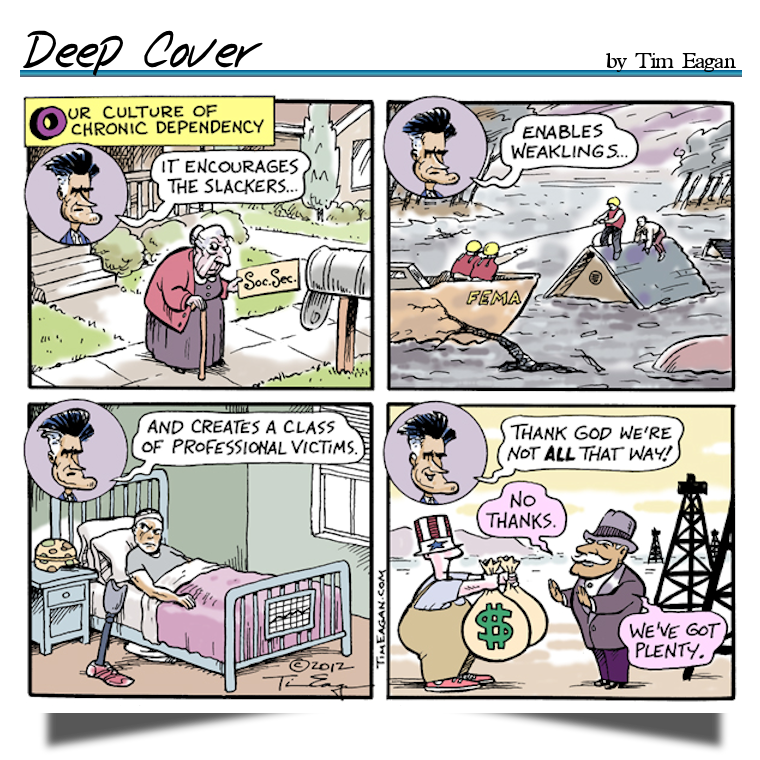
Greensite… on Mayoral Endorsement… Steinbruner… Town hall meeting for Watsonville Hospital… Hayes… back next week!… Patton… I’m Voting “Yes” On Proposition 40… Matlock… revolution…fused…flyover… Eagan… Subconscious Comics and Deep Cover … Webmistress serves you… Language idiosyncrasies… Quotes on… “Pronunciation”

|

GETTING CLOSER. Halloween is coming up, then the election, then Thanksgiving, and then it’s almost Christmas! I know you all know this, but hoo boy is time flying! I’m going back east to Delaware for a few days in November to attend my aunt Nancy’s memorial service. I’ll see cousins I haven’t seen since 1991, and I’m really looking forward to it! Obviously I’m sad that I won’t see Auntie Nan. She was a riot, and one of my favorite people ever.
I said “I’m going back east”, and had a think about why we say that. Turns out, as I actually deduced myself, that the terms “back east” and “out west” come from the history of U.S. westward expansion. The west was open and “out” ahead of you, and where you came from was “back east”.
Language. Gotta love it! 🙂 See you next week!
~Webmistress
FEAR STREET PTS 1, 2, 3. Netflix. Series. (6.6 IMDb) 
What if… Back to the Future was a horror movie?
I know, I do a lot of “spooky season” reviews, but next time I promise you the finest bleakness and most saturated human suffering I can find. Maybe something from Siberia.
For now, though, Fear Street, based on the novels of R.L. Stine (not quite Gersberms territory, considerably more adult).
Fear Street is set in Shadyside, a darker mirror of its neighboring town, Sunnyvale. Seems Shadyside has a long and bloody history of serial killers, dating back to a witch’s curse in the 17th century.
Cue the dates. The first film takes place in 1994 (with echoes of Scream), the second in 1978 (set at a summer camp, you do the math), and the third in 1666 (with a healthy dose of Witch Hysteria). All one story, not sequels, but a literal jump backward through time, from one chapter to its predecessor, eventually bringing us full circle to the ’90s. Kiana Madeira’s character, Deena, anchors the story, although Sadie (Stranger Things) Sink’s character, Ziggy, gets plenty of attention as well.
Despite its slasher trappings, Fear Street has more in common with Back to the Future than with most horror franchises. These aren’t three separate stories connected by a recurring menace, but a single, contiguous narrative unfolding across three films and three centuries. Each installment recontextualizes the others, making the trilogy considerably more than the sum of its parts.
There’s a fair amount of gore, but the emphasis is on the interconnected stories rather than serving up another helping of Purina Slasher-Chow.
I haven’t watched what appears to be a disappointing, after-the-fact fourth film set in the same universe, but the original three are well worth a watch. Watch them in order, and think of them as one long movie. Because, really, that’s what they are.
~Sarge

BELOW. Netflix. Series. (6.3 IMDb) 
Below keeps threatening to be a deep sea eldritch horror movie, but it soon becomes plain who the real monster is, and, like anyone who grew up here, we know the townies are the real heroes. Set in the severe beauty of a Newfoundland fishing village wrestling with something …below. Below features a solid cast, bleakly beautiful cinematography, and a mystery that rises and falls with the sea, on various fronts. Not brilliant, but a solid enough tale. Worth a watch.
~Sarge
MONSTER MOVIE ORIGINS 
IT’S SPOOKY SEASON! Let’s step back from the Universal canon: Karloff, Lugosi, Chaney Jr., and company. Go back just a couple of decades and you’ll find essentially the same lineup, only quieter.
As a kid in the early ’70s, I devoured movie history books, falling in love with films I’d never actually seen. They certainly weren’t showing up on TV. For years I assumed Edison’s “Frankenstein” existed only as that one tantalizing photograph in the history books.
Then came the internet, and suddenly I could watch a film I’d wanted to see since childhood. A hole in my heart I hadn’t even realized was there had finally been filled.
And there’s the original “Nosferatu”, an unauthorized adaptation of Bram Stoker’s “Dracula”. Stoker’s estate sued and won an order to destroy the film. Fortunately, prints had already circulated abroad, or we’d have lost this masterpiece entirely.
So here’s the original monster lineup, before Universal made them household names:
- Frankenstein
- J. Searle Dawley’s “Frankenstein” (1910), produced by Edison. [Watch]
- Dracula
- F. W. Murnau’s “Nosferatu” (1922). [Watch]
- Wolf(wo)Man
- Henry MacRae’s “The Werewolf” (1913), written by Ruth Ann Baldwin. Sadly, a lost film.
- The Mummy
- Georges Méliès’s “Le Monstre” (1903). [Watch]
- Dr. Jekyll and Mr. Hyde
- John S. Robertson’s “Dr. Jekyll and Mr. Hyde” (1920), starring John Barrymore. [Watch]
- The Phantom of the Opera
- Rupert Julian’s “The Phantom of the Opera” (1925), starring Lon Chaney. [Watch]
- The Hunchback of Notre Dame
- Wallace Worsley’s “The Hunchback of Notre Dame” (1923), also starring Chaney. [Watch]
YouTube is a treasure trove of early cinema. If you’re inclined to explore the roots of spooky movies, there’s also *Häxan* (1922), *Metropolis* (1927), *Vampyr* (1932), and plenty more.
They’re not just historical curiosities. They’re worth watching.
~Sarge
STEPHEN KING: A NECESSARY EVIL. Prime Video, Magellan TV. Movie. (7 IMDb)
Stephen King: A Necessary Evil – welcome to Spooky Season!
“Quadriplegic … unwed mother … telekinesis… waffle hut… and drat, aliens again” – Stephen King with his plotting dartboard.
Stephen King is one of those authors whom I enjoy as a person, but who makes my teeth itch as a writer. Which is why I really enjoyed “Stephen King: A Necessary Evil”- all about King and how/why he thinks about things. Behind the mind of the Shining, Misery, IT!, Stand By Me, the Green Mile, Shawshank Redemption, etc. Not spooky at all, except in just how much he has written (over 200 short stories alone), and impacted readers around the world for the last 5 decades. Fully worth a watch (and no surprise aliens at the end)
~Sarge
PRACTICAL MAGIC 2. In theatres. Movie. (6.3 IMDb) 
Practical Magic 2: Magical Boogaloo… The romantically cursed Owens sisters are back, along with the principal cast: Sandra Bullock, Nicole Kidman, Stockard Channing, and Dianne Wiest. Joining them are Joey King and Maisie Williams as Sally’s daughters, who have inherited both the family gift and its rather unfortunate fine print.
The basic premise, for those who missed the original: an Owens ancestor, determined to protect herself from the heartbreak of love, cast a curse that has plagued the family for generations. Any man who falls in love with an Owens woman dies. This time around, it’s the younger generation’s turn to deal with the problem.
Unfortunately, the story has been so drastically truncated from Alice Hoffman’s novel (The Book of Magic) that both the plot and the characters suffer. Maisie Williams, in particular, is completely wasted. It’s fun to see everyone together again, but the whole thing feels fragmented, as though large chunks of the story were left on the cutting-room floor.
A pleasant bit of fluff if you’ve got the time. Otherwise, wait for the streaming release. Worth a casual watch, but hardly worth a trip to the theater.
~Sarge
|
Sarge, aka Jeffery Sargent, cut his teeth on the Golden Age of Hollywoood on TV and with regular trips to the Sash Mill. Film classes then, at Cabrillo with Morton Marcus, broadened his scope – he found he preferred Keaton over Chaplin, and Akira Kurosawa was his Yoda. Sarge spent 15 years working in Special Effects, on everything from Starship Troopers to Battlestar Galactica. He is a staunch geek who has a weak spot for Cozy Mysteries and loathes “Reality” shows. While he doesn’t care for the unrelenting banal horror of “True Crime”, he licks his lips over a twist like the end of Chinatown. Email Sarge at JeffLSargent@gmail.com |
October 19, 2026

The following Guest Commentary was printed in the Sentinel on October 18, however the last paragraph was left out. Reprinted here in its entirety.
Why would I endorse Ryan Coonerty for mayor? I’ve been asked that question several times. Some of the reasons are explained below.
I learned a lot running as a mayoral candidate for the City of Santa Cruz. It was my first attempt at elected civic office, although I have been active in city politics since 1980.
I campaigned on several important issues, foremost being the issue of overbuilding. Using data, I demonstrated that the city is going too fast with permit approval of big projects and far beyond state housing mandates. We are well past the “we need housing” mantra and even the “we need affordable housing” chant strikes an off note when you know there is no tracking nor evidence that such housing is mainly going to locals and local workers.
Also troubling is the city’s upcoming reapplication for what is called a state prohousing designation, which sounds cool but is really a give-a-way of even more local control. To receive “points” for a chance to access state funds, the city is required to enact policies that end public hearings, allow housing projects on public land, allow greater project density, remove parking minimums and rezone single family neighborhoods for increased density. Totally voluntary. The city does not have to reapply. Only a seasoned civic leader with firm policy understandings will be able to weigh this designation versus further loss of local control.
During the fourteen primary campaign forums, Ryan Coonerty listened to the data I presented which helped him reassess his assumptions around housing development. While state laws do box us in, and neither candidate can ignore that fact, Ryan has ideas and strategies to push back against some of this development. His detractors have tried to discredit his sincerity on this issue, but I disagree. I have found Ryan to be sincere and thoughtful. Most importantly he has the experience, contacts and knowledge to get the work started on day one, providing leadership for Santa Cruz at the state level, including at the League of CA cities which just passed a Resolution to push back against the negative impact of state housing laws.
His opponent, Ami Chen Mills, has stated that she supports “rezoning for increased multi-family housing and condos in our neighborhoods.” Such an increase in density of housing in single-family neighborhoods would be in addition to the large six and eight story projects, not instead of them. State law already allows lot splits, accessory dwelling units and junior ADUs by right. Rezoning for apartment developers on top of all this would change our neighborhoods forever. I don’t support this and neither does Ryan. Ami’s campaign mailers don’t mention her support of rezoning single-family neighborhoods, an omission I find troubling.
Besides confronting overbuilding, the other issue where I’m in agreement with Ryan is on the complex issue of the unhoused population. I supported the Oversized Vehicle Ordinance (OVO), the lengthy attempt to address long-term parking of lived-in motorhomes along city streets and in neighborhoods with associated garbage, sanitary and environmental impacts. Ami opposed the OVO.
I would like to see the end of encampments in our city parks and open space lands. Only Ryan has made his position clear on taking action to address this issue of major concern to most of the community. Ami’s position during the primary, as reported by Santa Cruz Local, is to open small partially-managed camps as homeless shelters. There’s no mention of homeless camps in her latest mailer.
People have reacted to my endorsement of Ryan Coonerty for Mayor in a variety of ways. Most contributors to my campaign who expressed an opinion have been positive. Some of Ami’s supporters have been civil in disagreement; others have been hostile and insulting. I’m a free-speech absolutist, so that’s ok. It reveals far more about them than me. From the outset, I communicated clearly that I was not part of a slate opposing Coonerty. I ran an independent campaign on the issues.
I’ve listened, I consulted with people whose objectivity I trust, I’ve evaluated each candidate carefully on their positions and on their leadership skills and the conclusion is clear. The more experienced, better prepared candidate who supports issues that I judge as critical to the future of Santa Cruz is, hands down, Ryan Coonerty.
| Gillian Greensite is a long time local activist, a member of Save Our Big Trees and the Santa Cruz chapter of IDA, International Dark Sky Association http://darksky.org Plus she’s an avid ocean swimmer, hiker and lover of all things wild. |
Find out what the nurses at Watsonville Hospital have to say about the hastily-made decision by the Pajaro Valley Health Care District Board at a Special Meeting last month to cut critical care services for labor and delivery, neonatal intensive care, and post-partum units. This Saturday, 12:30pm-2pm at E.A. Hall Middle School (201 Brewington Avenue, Watsonville), learn what is happening and why the nurses are urging the Community to immediately contact the Board and demand these essential services remain open…’The risks of this hasty plan to close vital services are just too high.”
Contact the Pajaro Valley Health Care District Board: e-mail: info@pvhcd.org or telephone (831) 763-6040, or visiting/mailing the office at Kathleen King Community Room, 85 Nielson Street, Watsonville, CA 95076
The Board next meets on Wednesday, October 28 at 5:15pm.
COUNTY FUNDS ARE IN THE RED BUT CEO JUST GOT A BIG SALARY INCREASE
Actions speak louder than words, and Tuesday’s Board approval of a hefty salary increase for the CEO, when the County leaders claim money is so short, showed poor leadership all around. Although she has worked as the CEO of Santa Cruz County for less than one year, the Board of Supervisors approved advancing Nicole Coburn’s salary to the next step from Step 6 to Step 7 increasing the hourly rate from $188.06 to $197.47 following her annual review during Closed Session earlier this month.
She now joins the big club of County management employees earning nearly half-a-Million $ annually.
State law required the Board to take the action in publicly open session, so the item was placed on the Consent Agenda, with a brief mention at the beginning of the meeting to let the public know of the consent action.
This is how the County will spend any Measure E half-cent sales tax increase monies, should it be approved. Don’t be fooled into thinking otherwise.
MAKING CEO SAFE?
The Board of Supervisors approved spending $88,475 to remodel the CEO public lobby and install security cameras on the fifth floor of the 701 Ocean Street government building to help the CEO and her staff feel safe. No one will be monitoring the cameras.
Apparently, someone stole a laptop computer from the CEO office area. The CEO somehow pointed the finger at the public.
Many thanks to Supervisor Justin Cummings for pulling this item from the Consent Agenda, allowing for a meaningful public discussion. It was too bad that Chair Martinez placed it at the very end of the day’s agenda as Item 11.1, when there were only two members of the public left in the audience.
When he questioned why the CEO lobby would be made more secure than the Board of Supervisor lobby, CEO Coburn assured him the five new cameras will provide adequate coverage to that lobby. She did not publicly discuss the extensive remodel her lobby area will be enjoying.
When Supervisor Cummings questioned the dollar amount for the project, CEO Coburn was dismissive.
She only laughed and said, “I thought it would cost alot more than this!” Well, well, it seems money is no object for the CEO.
She mentioned that there are no cameras on the fourth floor either. I guess the safety of those employees is not on her list of important things to fund.
Take a look at Item 11.1 to see how the County is further squandering our money
COUNTY WANTS TO SPEND $4 MILLION TO BUY 14-ACRE FARM?
Why does the County want to spend nearly $4 Million to buy a 14-acre farm with greenhouses in Watsonville, especially when money is so short, and the Board had to authorize using $43 Million from the Reserve Fund to balance the budget? The Board considered this during Tuesday’s Closed Session negotiations for property at 1203 Buena Vista Drive (APN 052-01-111). Under mandate of the voters in 1978, Measure J requires ag land be preserved for agricultural uses.
Is the County planning to launch a 14-acre Community Garden to help with the food insecurity predicted by federal funding cuts???
Stay tuned.
THIS FRIDAY ON KSCO
Listen in to KSCO Radio this Friday at 2pm to learn about KalKar Pond in Santa Cruz, Bratton on KSCO will be at 6pm with a great discussion of some of the issues raised during the Santa Cruz County Board of Supervisor meeting Tuesday, and likely other issues as well, including the public hearing for the large solar array planned for Felton at the intersection near Safeway. That project will be considered on October 28 by the County Planning Commission. I suspect that Mt. Hermon is planning to include a battery energy storage system (BESS) on the adjacent flat parcel.
Listen in and join the conversation! AM 1080 and FM 104.1, livestreaming from www.ksco.com
MAKE ONE CALL. WRITE ONE LETTER. ATTEND A PUBLIC HEARING AND ASK QUESTIONS.
VOTE NO ON MEASURE E.
DO ONE THING THIS WEEK AND MAKE A BIG DIFFERENCE.
Cheers,
Becky
|
Becky Steinbruner is a 30+ year resident of Aptos. She has fought for water, fire, emergency preparedness, and for road repair. She ran for Second District County Supervisor in 2016 on a shoestring and got nearly 20% of the votes. She ran again in 2020 on a slightly bigger shoestring and got 1/3 of the votes.
Email Becky at KI6TKB@yahoo.com |
Back next week!
|
Grey Hayes is a fervent speaker for all things wild, and his occupations have included land stewardship with UC Natural Reserves, large-scale monitoring and strategic planning with The Nature Conservancy, professional education with the Elkhorn Slough National Estuarine Research Reserve, and teaching undergraduates at UC Santa Cruz. Visit his website at: www.greyhayes.net
Email Grey at coastalprairie@aol.com |
Saturday, October 17, 2026

Joseph C. Sternberg, writing in yesterday’s Wall Street Journal, seems to think that California State Proposition 40, which appears on California’s November 3rd ballot, is actually “French” in its origins. Frankly, I don’t really get that alleged “French Connection,” but I do understand that Sternberg thinks that Proposition 40 is a “dog,” to quote him on the subject. Here’s a link to Sternberg’s opinion piece.
Despite what Sternberg has to say, I am planning to vote “Yes” on Proposition 40 (and since I believe in “voting early,” I am actually planning to turn in my ballot later today, as part of a “NO KINGS” rally being held at 10:00 o’clock this morning, down at the Santa Cruz County Governmental Center, 701 Ocean Street in Santa Cruz. I am pretty familiar with the location, since I worked there for twenty years, from 1975 to 1995.
Here is why Sternberg thinks that Proposition 40 is a “dog” (emphasis added):
Proposition 40 has a good claim to be the most significant item on the ballot anywhere in America this cycle. That’s only partly due to the fiscal math and the economics of the proposed 5% tax on those with assets above $1 billion. On the merits, the policy is a dog.
As dangerous is the attitude Proposition 40 embodies. Its premise is that any and all private wealth constitutes an illegitimate diversion of resources away from the state. Despite the initial application to fortunes only above $1 billion, one discerns in the academic literature behind Proposition 40 no limiting principle.
This is foreign to America’s political tradition, in which property rights are a foundation of our liberty. The tax is entirely redistributive and punitive, and in this regard its philosophical radicalness is underappreciated. Probably because the danger it poses to the economy is so distracting.
I do not think that the premise underlying Proposition 40’s proposed one-time tax on billionaires is that “all private wealth constitutes an illegitimate diversion of resources away from the state.” I think that the premise is that “we’re all in this together,” and that everyone in our society helps create both individual and societal wealth, and that it’s both appropriate and fair – not to mention necessary – to make sure, when we face very difficult challenges, that those at the very highest income levels contribute fairly to our ability to deal with our rather daunting problems.
If you think that Proposition 40 treats billionaires unfairly, please consider the following, from The National Bureau of Economic Research (emphasis added):
We estimate income and taxes for the wealthiest group of US households by matching Forbes 400 data to the individual, business, estate, and gift tax returns of the corresponding group in 2010–2020. In our benchmark estimate, the total effective tax rate—all taxes paid relative to economic income—of the top 0.0002% (approximately the “top 400”) averaged 24% in 2018–2020 compared with 30% for the full population and 45% for top labor income earners. This lower total effective tax rate on the wealthiest is substantially driven by low taxable individual income relative to economic income. First, the C-corporations owned by the wealthiest distributed relatively little in dividends, limiting their individual income tax unless they sell their stocks. Second, top-owned passthrough businesses reported negative taxable income on average in spite of positive book income, further limiting their individual income tax. The top-400 effective tax rate fell from 30% in 2010–2017 to 24% in 2018–2020, explained both by a smaller share of business income being taxed and by that income being subject to lower tax rates. Estate and gift taxes contributed relatively little to their effective tax rate. Top-400 decedents paid 0.8% of their wealth in estate tax when married and 7% when single. Annual charitable contributions equalled 0.6% of wealth and 11% of economic income in 2018–20.
Do you remember that Sherlock Holmes story about “The Dog That Did Not Bark“? Sternberg calls Proposition 40 a “dog.” But, in this case, it turns out that the dog isn’t barking because there really isn’t much to bark about. There isn’t anything too unfair about trying to have the billionaires pay something, by way of taxes, that might come close to what the typical labor income earner is paying. You know, someone like me or you!
|
Gary Patton is a former Santa Cruz County Supervisor (20 years) and an attorney for individuals and community groups on land use and environmental issues. The opinions expressed are Mr. Patton’s. You can read and subscribe to his daily blog at www.gapatton.net
Email Gary at gapatton@mac.com |
A recent interview in Current Affairs by editor Nathan J. Robinson with New Yorker, and former Oklahoma interior designer and outspoken progressive voice, Jennifer Welch, has a rather disarming title: ‘The Only Way Out is Revolution — Why Moderation Won’t Beat MAGA.’ Welch has gained notoriety in her fiery commentaries on her Substack podcast, ‘I’ve Had It‘, and is willing to take aim at both Republicans and Democrats as a “rage-filled progressive” as she calls herself. In a previous life she describes herself as a “corporate Democrat with faith in the establishment,” but has grown disillusioned with a party she believes has failed to meaningfully resist the rise of the far right. In her conversation with Robinson, she discusses her new book, ‘Not Today, Fascists: The Lies That Got Us Here, and the Truths That Will Reunite Us.’
Welch details what it was like to grow up in the Bible Belt, what it taught her about Christian nationalism and the rise of MAGA, and why the Democrats stay on the losing path to a Republican Party with deeply unpopular policies. She tells Robinson that those she associated with when growing up had their whole identity in being Christian AND Republican, “It’s very fused together. There’s hardly any separation from those two entities, and even before Trump the idea of Christian nationalism in the Bible Belt was ubiquitous. The political right brilliantly projected themselves into churches because the number one indicator to determine if somebody votes is church attendance.” With so little daylight between the two entities, she wasn’t surprised to see Trump’s rise with all the evangelicals racing to his side, not as a Christian man but an evangelical Christian man, a Southern evangelical. “Think about a megachurch pastor, and then think about Donald Trump. There’s not a big difference there.”
Robinson asks Welch about her comments about church hypocrisy, when outsiders fail to see the adoration of Trump in these communities: “But how do you explain the fact that he’s a totally un-Christian and sinful man?” Welch’s view is that “These people are THAT. These people are exactly like him.” She says she can’t begin to tell how many such scandals she grew up with, growing up as an atheist whose friends wouldn’t let up on trying to convert her. “They wanted me to get saved, and their pastors were always involved in some grab-ass with the secretary or some person who went to the church. There was always some sort of scandal, and how they deal with this in evangelical Christianity is forgiveness with zero accountability. Monday through Friday, it’s play with the secretary, maybe do gay stuff, and come Sunday, ‘Jesus, please forgive me,’ then rinse and repeat.”
Welch sees the familiarity to Trump’s moral depravity and all his problems, to where it became easy for evangelicals to forgive him for the Access Hollywood tape or any of his shortcomings, because their own culture is moral depravity. Saying the mantra, “Oh, I’m sorry, Jesus, forgive me,” then sweeping it under the rug before moving down the road to the next scandal. Robinson points out that Trump seems to be leaving out the part where forgiveness is sought on Sunday. He asks Welch if she sees red states turning blue without a kind of progressive politics fusing with Christianity, and refers to James Talarico in Texas, speaking in a Christian register with democratic and progressive values — “How do you think progressives should approach religion?” Welch expresses her hope that Talarico has the “magic potion” to accomplish that, but is skeptical of the electorate who keeps returning Ted Cruz to office.
And, this is where Welch offers one condemnation of the Democratic Party, feeling they have abandoned the 50-state strategy. Offering her home state of Oklahoma, she claims, “Everybody says, ‘We need to make Oklahoma better, blah, blah. Well, if you don’t like Oklahoma, Alabama, Lousiana, or any of these supermajority states, it’s a Republican’s fault. This is Republicans’ policy. But there’s no Democratic Party there to message this because they’ve abandoned all 50 states. So then that leaves these crazy-ass Republican primaries where they out-crazy each other, and it’s a race to the bottom. I would be interested to see if a progressive — and it might take four or five election cycles — really went to all of these states and simply say these MAGA politicians or Republican politicians are liars. They’ve been lying to you. They use your faith to lie to you.”
Her solution is to play offense instead of defense, instead of capitulation to the narrative that we have to be religious — something Democrats are overlooking. Tell people plainly that Ted Cruz is a liar — “Lying Ted Cruz” as Trump calls him! She sees the Democratic Party with too many “bought and paid for” officeholders, who offer only word-salad non-answers, which doesn’t fly in flyover America. She agrees with Bernie Sanders who believes the idea of right-left spectrum wins by being closest to the political-median view is wrong, and that Bernie has more of a chance in appealing to Trump voters. In her estimation, people such as Bernie, or Abdul El-Sayed, or Zohran Mamdani can make the case because “they’re not political prostitutes,” when they explain the problem that neither party has delivered the goods, that voters have been lied to.
Robinson questions Welch on her opinions of Kamala Harris after reading comments in her book that Kamala’s platform was anything but leftist. “It was pro-police, pro-Israel, and pro-business, as she reversed her original promises to ban fracking and decriminalize illegal border crossings, not as an abdication of values, but in the interest of seeking consensus,” she wrote. Welch views Harris as an accomplished, exceptional, and incredibly smart human being, and she was all-in to advance her to the presidency as the first Black female to hold the office, being completely mystified how Trump got elected twice. She concluded that one of the reasons was the capitulation to right-wing framing by Harris, with voters failing to see much of a difference between her and Trump. Welch says Harris should run again if she wishes, but will not get her support in the primaries unless she comes out with some different tactics — any sort of corporate Democrat or focus group messaging is not going to play well with the electorate as we have seen.
Welch has been outspoken in telling Democrats to be honest and courageous in calling things what they are, specifically, the Israel-Palestine issue — referring to Kamala Harris‘ agreeing with the Biden administration’s refusing to have a Palestinian speaker at the Democratic convention. In going forward, the Democrats must forthrightly confront the genocide in Gaza, necessary if they want to be a party of moral values. To Welch, the US is funding a bad movie where they are the bad guy responsible for putting sniper bullets into the bodies of toddlers, with total impunity. She refers to the rural towns of Oklahoma where schools are so poorly funded students are lucky to attend four days a week, and even luckier if they get a free lunch — the state ranks 50th in education.
She thinks of the families from which those students come, who might have to forego cancer treatment and file medical bankruptcy because tax money is prioritized to assist Israel in killing Palestinians. “And there’s no room for daylight on this. The United States of America is on the wrong side of history — we are the bad guys in this story. It’s crystal clear, and the more you look into it the worse it gets.” Robinson tells Welch her book is appreciated, along with her perspective and dedication to criticizing and exposing Christian nationalism and the right — the Christofascist state in her terminology. He reads her conclusion: “The only way out is revolution,” as she writes of Republicans joining hands with the Evangelical Church, preying on the faith and the worst impulses of the devoted. “The Democratic establishment rolled out the red carpet by refusing to put up a fight. I’m filled with rage and I’m not holding any of my punches. America deserves better than the Democratic leadership that colluded with the right to bring this authoritarian takeover, playing patty-cake with the fascists and writing strongly worded letters,” she wrote, telling Robinson that hearing him read those words only makes her mad all over again.
Welch says there are not enough words that can describe how Chuck Schumer and Hakeem Jeffries are NOT the men of this moment, describing how Jeffries secretly met with Jared Kushner, and Schumer telling donors, “My job as Senate Majority Leader is to make sure Israel gets every cent they can get.” She talks of evil fascists being propped up by evil billionaires, while bringing up the big party with visiting communist Xi Jinping — “Oh, the communists are coming to get us,” as if they haven’t already! The lack of resistance from the Democratic leadership angers Welch, especially the way supporters receive treatment in such a patronizing way — “We’ll give you your marching orders. Here’s who you can listen to, here’s who you can’t listen to,” which works for MAGA, but the Democratic side is now waking up as they see funding for both sides coming from the same sources. Welch is hopeful for a rebellion within the Democratic House, seating someone other than Hakeem Jeffries; she sees no way Democratic Senators will continue with Schumer, and he knows it.
Robinson asked Welch to talk about her radicalization process, being an unlikely revolutionary type as a once-corporate Democrat, just a simple interior designer from Oklahoma. The eye-opening moments for her were in hearing Biden’s insistence that he was a candidate for reelection, as she saw fascism sitting on the deck. “He finally did the right thing and Kamala was in,” but another flash hit her — “This is b.s.,” as she saw Kamala parading around with Liz Cheney, “a great incubator of all of this fascism,” who voted with Trump 90-something percent of the time, the only disagreement being his January 6 coup attempt. Welch recalls the clip of Cheney, standing with a right-wing GOP Bible thumper, verifying that fourth-term births were resulting in baby killings, sort of like Trump’s charge that kids were getting sex changes in school. “You can’t even get an aspirin for a kid in school, much less a sex change,” she asserts.
“Cheney makes the statement with such impunity, little pushback from the Democratic Party, feeding into Oklahomans who would rather vote for a rapist to have more rights than themselves, or for their daughter — Liz Cheney incubated that. Cheney is in her position because of the progressive feminist movement, climbing the ladder that so many people fought for her, then promoting a lie from her top position that feeds the horrific anti-women erosion of women’s rights,” rages Welch. In seeing Kamala participate in fundraising with Cheney, she saw this one thing: “They’re never going to like you, Kamala, for capitalizing to their framing.” Her rage over this was almost released on her podcast at the time, but wanting Harris to win took precedence, and not wanting to be a bad messenger, it was cut. After the election, Welch started reading more independent journalism, stopped watching MSNBC, concluding that funding for both parties was out of control, which led to her radicalization.
Welch concurs with Robinson in his summation of the Obama years, which were a big wakeup call for the moderator, seeing Obama as a compromiser in his development of a health plan, and being pro-Israel — even though Netanyahu called him an antisemite. “With Obama, who gave Republicans so many concessions that they came back and said, ‘Thanks, but you’re a communist who’s destroying America,'” observes Robinson. Despite her agreement, Welch says she was “100% in the tank for Obama,” and still has a strong affection for him; yet, we should still lodge strong critiques of past administrations, such as Bush’s Abu Graib tortures and his lying to get us into the Iraq War, acknowledging that the Democrats had a big part in that, as well, with little to zero in accountability.
The lesson for Democrats is to examine what they are doing now, but go in and govern — put your accelerator to the floorboard and go full tilt like Mamdami is doing in New York without ceding points to depraved fascists — tough if they don’t like it! We have to fight for better healthcare, better pay, a better infrastructure, so why do we need approval from Republicans who make a complete catastrophe of government when they’re in charge? Welch says in her lifetime, it’s been war, deficit, recession — rinse, repeat — every single time the GOP is in office. Robinson sees Trump’s unpopularity rising because the electorate sees that electing someone manifestly incompetent and corrupt produces a country nobody wants to live in, yet he sees no promising Democratic contenders that people could support. In her book, Welch’s perspective is that fascists can be defeated because they are horrible, pushing through things people don’t want or like, but without a meaningful alternative, they might continue in power.
Welch says, “We need to take it back to the way it was, and we just need to govern incrementally; both parties contributed, Republicans more so, but both contributed to favoring corporations over human beings, favoring money over human beings, and not delivering for the middle class and working class Americans materially.” She says we may elect someone like Newsom in 2028, who will serve one term, to be followed by a “Tucker Carlson or some other nut because the country is so desperate.” Welch is convinced that the only thing saving us from Donald Trump is just how stupid and incompetent he is — if he were smart he wouldn’t be so brazen and going so fast, “but the fact that he’s so emboldened and moving at such a fast click, being so incompetent in his execution, that may very well save us.” Taking a page from Trump, the Democrats must learn that when you have power, use it, every bit of it, and GOVERN.
Robinson expressed his opinion that the lesson of 2020 wasn’t learned, only allowing Biden to squeak into office, probably because of COVID — almost an act of God? Trump’s virus response totally discredited his administration, barring his reelection. With a contiguous second term, it probably means that Democrats would have had no strategy for beating MAGA in succeeding elections. Welch says Trump 2.0 has been so devastating because he surrounded himself with incompetent, disqualified people — sycophants all, with complete obsequiousness to him. And she is still at a loss of why industry titans rushed to prop up a fascist. “They’re making trophies for him. Apple’s Tim Cook presented Trump with a trophy in what I liken to a humiliation ritual and debasing himself. You’ve got a net worth that could choke a bull, and you’re making up some c.s. award and taking it to this toddler to appease his ego?” Once upon a time, Welch says she regarded phrases like ‘billionaires shouldn’t exist‘ to petty jealousy, but now she agrees that “this class of billionaires should not exist. They are horrible people, horrible.”
On the Supreme Court, Welch says it’s insane that we have a court that is so reckless and so immoral in what they value — most claiming to be Christians. “They lead with their faith, yet value money over people. We constantly think the Supreme Court is protecting Trump, but no, they are protecting corporations, protecting a future where they want this type of rule that plunders democracy,” she charges. If there is the predicted blue wave in the midterms, she is hopeful that the oversight committee will impeach Thomas, Alito, and Roberts, and not ending up with a bunch of Democrats who “don’t want to upset the structure of the court.” She says the court is an evil entity with nobody to report to, the only people on the globe that don’t have a boss, and she would like to see the Democrats completely restructure the Supreme Court.
Robinson tells Welch that he has written a book on JD Vance, who he went to law school with, though never interacting with him personally, and that Vance follows him on Twitter. His book is entitled ‘Hillbilly Hypocrisy – JD Vance and the Dark Future of MAGA Politics,’ which deals with JD’s political transformation, while arguing that the post-Trump right will serve oligarchs and Christian nationalists seeking power and wealth. He still questions whether or not Vance will be a successful heir to Trump, or if his awkward ass-kissing will cause him to fumble the ball. Welch says he has no identity at all, changing his name three times, and ditto for his religion. “He has an Indian wife and mixed-race kids, and he refuses to condemn a racist Nazi group chat, and says stuff like, ‘Usha can’t help it that she’s not white.’ It’s just the weirdest. He’s the weirdest guy, ” she offers.
Welch recalls that Ron DeSantis was going to be the new Trump before his spectacular face-plant, predicting that Vance is on the same track. She reminds us that Silicon Valley’s Peter Thiel took Vance, a chubby, sloppy, poorly dressed guy, and combed his hair, thinned him down, remaking him into the “country’s top prostitute, and that’s really saying something considering who our First Lady is.” Both Vance and Ted Cruz have both hit on the fact that “if you have a face that people consider punchable or inherently repulsive, get a beard. Cover the face, and all of a sudden you look like kind of a normal guy. Vance has said that the most important moment of his time in law school was meeting Peter Thiel, which is really funny because he also met his wife in law school.”
|
Dale Matlock, a Santa Cruz County resident since 1968, is the former owner of The Print Gallery, a screenprinting establishment. He is an adherent of The George Vermosky school of journalism, and a follower of too many news shows, newspapers, and political publications, and a some-time resident of Moloka’i, Hawaii, U.S.A., serving on the Board of Directors of Kepuhi Beach Resort. Email: cornerspot14@yahoo.com. |
Each week, I will feature a selection of interesting and historically significant places in Santa Cruz County from the 1986 edition of Donald Thomas Clark‘s wonderful book, “Santa Cruz County Place Names: A Geographical Dictionary“, published by the Santa Cruz Historical Trust.
“Nuggets” If I find something topically relevant, but not necessarily directly related to the week’s selection, you’ll see it under the Nuggets heading. Note: for reasons of brevity, sources are usually dropped when I reproduce an entry. You can always email me if you’re curious, or, even better, buy a copy of the book!
What caught my eye about this week’s entry was a couple of things… firstly–the reference to Frederick Augustus Hihn (a very prominent figure in the history of Santa Cruz County); secondly–the inability of various mapmakers and chroniclers to spell his name correctly, yikes; and thirdly–the fact that the road is built on an easement, the text of which Clark quotes. Which I find interesting, as the fact that there’s a road / intersection there now is a byproduct of an agreement written 146 years ago not involving the actual sale of the land in question (which in turn has implications for how it can be used in the future, c.f. some of the discussion around aspects of building a rail and trail in Santa Cruz County along existing rights of way). Interestingly, his son-in-law, Volney Averill (mentioned below) is a co-signer on the easement as well.
Let’s see what we can find out about Mr. Schultheis (you can be sure I’ll be careful to spell the gentleman’s name correctly). Turns out, quite a bit! First of all, the entry for John Martin Schultheis on Find A Grave, which includes several pictures of his well maintained headstone, and a picture of his 1896 obituary in the Santa Cruz Surf and Superior Farmer (added in March of this year). Nice! Even better, an feature article in Mount Network News from February of this year, The Historical Schultheis Family by Debra Staab. Apparently Mr. and Mrs. Susan Schultheis helped nurse famous Santa Cruz resident Mountain Charley back to health after a grizzly bear attack (the subject of another article in the same issue), among other claims to fame (they lived near each other). The house they eventually constructed survived most of the last century, only to be destroyed in the Loma Prieta earthquake in 1989, and their descendants are still actively carrying forward the family’s history (Google Doc prepared by Debra Staab for the Loma Prieta Museum on the 150th wedding anniversary of John and Susan’s daughter Alice to the scion of another prominent local family, Volney Averill). The Loma Prieta Museum also has this entry on The Schultheis Family, which formed the basis for the article in the Mountain Network News above.

A note about my process. I love just randomly flipping through the book, scanning for something that catches my eye that I canfeature in the column. This week, it was “Chittenden” (Nathaniel W.), whose name is all over an area of Watsonville he and his family once owned. There are five separate entries. Just before that, there are six entries named after places where immigrant Chinese laborers once lived and worked. They played a very prominent role in California in the late 1800s and what happened to them is a tragic injustice; however, the subject deserves a bit more effort than I can make on impulse, so I’ll feature it in a future column, or maybe a small sequence of columns (more likely). Finally, as I was writing this part, after picking something a little bit less involved to write about from elsewhere in the book, I noticed a couple of entries just before the one for China Beach–“Chicken Alley”(!) and “Chickentown”(!), which will definitely be featured in an upcoming column!
A gap located on the Santa Cruz-Santa Clara counties boundary along the crest of the Santa Cruz Mountains, 1.2 miles southeast of Highway 17 and Summit Road. It is at the point where the present-day roads named Old Santa Cruz Highway, Summit Road, and Schultheis Road meet. It was adjacent to the former lagoon, now a cultivated field, named Schultheis Lagoon [in Santa Clara County.] The pass, road, and lagoon were named for John Martin Schultheis who was an early [1852] settler in the Summit area. Born in Bavaria, Schultheis migrated to the United States and crossed the plains from Ohio. The name has sometimes been corrupted; for example, in a story about the building of the Glenwood & Summit road that appeared in the July 27, 1914, issue of the Santa Cruz Surf the writer stated that ” …the road crosses the summit at a gap or depression known as Schultie’s
Pass…” And while Regal Map Company’s road atlas of Santa Cruz County (REG 1984) has listed Schultheis Road in the index, it is spelled Shulties Road on the map pages. On ORR (1966) it is spelled Schulties Road. Schultheis Road had its start in 1880 when an agreement was reached between landowners and Santa Cruz County:John M. Schultheis, Enoch C. Ellis, Volney Averill, F. A. Hihn to County of Santa Cruz
and F. A. Hihn:We the undersigned herewith grant to the County of Santa Cruz and to F. A. Hihn the right to construct maintain and operate a wagon road forty feet wide from the Soquel Turnpike near the North side of the J. M. Schultheis Lagoon and thence Southerly to Elbon and Hock’s mill near the East end of tunnel number three [3] on the South Pacific Coast Railroad substantially on the line of survey as made by M. V. Bennett in the month of September 1880.–from Hihn Record Book, Vol.3, p.51.


|
Thomas Leavitt is the husbandy thing to our illustrious webmistress. A resident of Santa Cruz (now part time) since 1993, his interests include history, technology, and community organizing. He started the world’s first self-service web hosting company, WebCom, located at 903 Pacific in May of 1994. He’s been part of too many community organizations to mention, and ran for City Council in the early aughts. Email Thomas at ThomLeavitt@gmail.com |
 “Pronunciation”
“My uncle is from Argentina, so I grew up hearing Spanish. My Spanish isn’t very good, but my pronunciation isn’t terrible.”
~Moby
“My father always wanted to be ‘Col-bear.’ He lived in the same town as his father, and his father didn’t like the idea of the name with the French pronunciation. So my father said to us, ‘Do what you want. You’re not going to offend anybody.’ And he was dead long before I made my decision.”
~Stephen Colbert
“I’ve heard every pronunciation ever, but the worst was when I was in New York for a radio show at some restaurant. On the door it said, ‘Now appearing: Kard Kiard.'”
~Karch Kiraly
“I get a different pronunciation at least every week. I think the worst one, or the funniest one I got, somebody called me, ‘Oh-gooz-man.'”
~Nnamdi Asomugha
“When you have to teach yourself how to say sounds, when you have to be highly concerned about pronunciation, it gives you a certain awareness of sonics, of the auditory experience.”
~Amanda Gorman
|
WHY DO WE PRONOUNCE… How words are pronounced in English is a topic of endless fascination for me. This is a guy I just found who does videos on it. Enjoy!
|
Direct questions and comments to webmistress@BrattonOnline.com
(Gunilla Leavitt)