Greensite… on who is driving the overbuilding in Santa Cruz?… Steinbruner… BESS, new housing by Cabrillo… Hayes… Fruit on the Monterey Bay… Patton… Hermon Husband, Revolutionary Hero… Matlock… on a break… Eagan… Subconscious Comics and Deep Cover … Webmistress serves you… Quotes on… “Commitment”

|
|
If you want to pitch in to
|

SHORT, SHORT SUMMER… My daughter just told me the other day that her kids are going back to school on August 12(!) In the name of all that’s holy, isn’t that just too soon?! What happened to school starting after Labor Day? It feels like school just let out! Summer barely started! We have a lot to stuff into what’s left of it.
DAYTRIPS. Speaking of, I follow a couple of California daytrip and travel accounts on tik tok, Facebook, and Instagram. I’m always excited when it shows something like Roaring Camp or Capitola, or any of the awesome things that are right on our doorstep. One of the things I’m really wanting to do is take the grandkids to Children’s Fairyland in Oakland. Supposedly, Walt Disney visited that park for inspiration when he was getting ready to realize his own vision. I’m really curious about it, and I promise I’ll tell you all about it, if and when we manage to get there!
~Webmistress
QUICK LOOK AT NETFLIX. Netflix. Series, Movie. 
Here’s some stuff that’s not necessarily current, but currently on Netflix:
Veronica Mars think Buffy, but with no vampires, and lots of class conflicts, roofies … and the result … and murder in a small California coastal town. Young Kristen Bell (The Good Place) lives with her disgraced cop/now PI father, and is determined to solve the murder of her best friend, and the case that tanked her father’s career. A fun watch.
The Dead Don’t Die think Night of the Living Dead directed by Wes Anderson. Only in this case, it’s Jim Jarmusch. Zombies in a small town, with Bill Murray and Adam Driver starring. Tilda Swinton is a samurai. Much more like his 80’s films.
Mindhunter was pretty amazing, on and off; the casting for Big Ed Kemper was spot on. Period piece that follows the building of the FBI’s “profiling” division, focused on this new thing: serial killers.
The Enola Holmes movies: Sherlock (Henry Cavill)’s little sister, Enola (Alone backwards), breaks free of an attempt to ship her off to a deportment school, and takes up the family business on her own. There follow adventures, romance (on her terms), and occasional visits by her anarchist mother, Helena Bonham Carter. The first is a lot of fun, growing less (for me) as the sequels went on.
Marty: Life is Short, let’s hope it’s not for him! I love Martin Short, so this was a gem. An autobiographical history, chock full of familiar clips, as well as previously unseen personal movies, and of course a tremendous group of cameos.
~Sarge

SUPERGIRL. In theatres. Movie. (6.1 IMDb)
Supergirl is 67 years old.
In that time, she’s been through a LOT of attempts to give her her OWN story instead of just being Jr. Girl Superman. She suffers here from 1) the Manosphere complaining that she’s not cute or “feminine” enough, and 2) people stuck on an older version of her, like comparing Super Friends Aquaman to Jason Momoa.
Loosely based on Supergirl: Woman of Tomorrow by Tom King, and honestly drawing from True Grit too, Supergirl stars Milly Alcock (House of the Dragon) as Kara Zor El, who leaves Earth to escape the shadow of her cousin, Superman, and the expectations piled on her while still dealing with PTSD from the destruction of Krypton. She ends up caught in a child’s vendetta and a race against time to get medical help for Krypto (played by Krypto, from Superman).
The pacing isn’t the sharpest, but the soundtrack is a banger, the effects are great, and Jason Momoa as Lobo is a role he was born to play. Despite haters and Rotten Tomatoes, well worth a watch.
~Sarge
GOOD GIRL’S GUIDE TO MURDER. Netflix. Series. (6.8 IMDb)
Think Nancy Drew meets True Detective. Five years after the apparent murder of a popular high school student, aspiring journalist Pip Fitz-Amobi decides the case doesn’t add up. What begins as a school project quickly turns into a deeper investigation, uncovering secrets, lies, and long-buried resentments in a town convinced the mystery was solved years ago.
The show’s biggest strength is Pip herself (Emma Myers – Jenna Ortega’s bouncy rainbow werewolf roommate on “Wednesday”): smart, determined, and believable as an amateur sleuth. While it never gets as dark as True Detective, it avoids feeling like a watered-down teen mystery, delivering genuine suspense, credible twists, and enough suspects to keep you guessing. Based on the novel by Holly Jackson, it’s a fast, engaging binge that captures the appeal of a classic detective story while giving it a modern true-crime sensibility.
~Sarge
GOOD OMENS 3. PrimeTV. Movie. (8 IMDb)
In 1990, fantasy legend Terry Pratchett and young comic fantasy mavin Neil Gaiman collaborated on a novel built around the question, “What if the Antichrist got switched at birth?” and Good Omens was born.
In 2024, the third season of Amazon’s adaptation of the late Terry Pratchett and Neil Gaiman’s Good Omens was put on hold after multiple allegations of sexual assault against Gaiman surfaced in the news.
The Amazon version of Good Omens thrived on the brilliant chemistry between David Tennant and Michael Sheen as Crowley, a demon, and Aziraphale, an angel, who have spent millennia on Earth in what increasingly resembles a Cold War marriage. Faced with the impending Apocalypse, both come to the conclusion that maybe it might be altogether better … NOT doing that.
Featuring a host of charming side stories that all somehow linked together, plus a simmering relationship between the two leads, the first season felt like a delightful Douglas Adams pastiche. Since season one adapted the novel itself, the second season came as a complete surprise. Crafted entirely by Gaiman, it leaned harder into the Crowley/Aziraphale relationship, along with a gloriously naked and amnesiac Jon Hamm as the angel Gabriel. A great deal happens, and it all ends on a heartbreaking cliffhanger.
Then came season 3 … NOT!
As allegations against Gaiman mounted, stretching from the mid-80s into relatively recent years, comics, films, and television projects tied to him began getting canceled or shelved, including Good Omens 3. Fortunately, Gaiman stepped away from the production, allowing fans to get a third season … sort of. Cut down to a single feature-length finale, it still manages to wrap up a surprising number of story threads, and may even produce a few sniffles.
Gaiman’s problematic history aside, worth a watch.
~Sarge
PANTHEON. Netflix. Series. (8.5 IMDb) 
What if the threat isn’t AI? What if it’s UI: uploaded intelligence. Human brains destructively scanned, living only in the cloud. “Pantheon” explores this idea as exquisite, real science fiction. Not cheesy animated sci-fi melodrama, but a genuine exploration of love, grief, immortality, endless simulations, conspiracies, global politics, and so much more.
The animation is restrained, there to serve the story rather than distract from it. The characters are rich, not cardboard cutouts, whether good or bad. No supervillains. No Mary Sues.
It’s a dense story, so if science fiction concepts tend to lose you, this may not be for you. But if they don’t, this absolutely deserves a watch.
~Sarge
STRANGER THINGS – TALES FROM ’85. Netflix. Series. (5 IMDb) 
Stranger Things exits stage left…then pops back out for one more bow.
Set between seasons 2 and 3, this animated take brings back the core crew without sanding things down for kids. It’s not anime or cheap knockoff – dipping their pens in the Spiderverse/Arcane inkwell, with a creative, stylized look. It’s also more focused than the later live-action seasons, trimming most of the adults and zeroing in on the kids. Best of all, Will Byers actually gets to be a character instead of a punching bag, helped by the addition of Niki, an Amazonian punk rocker who connects with him over their shared outsider status. The recast voices are a little jarring at first, but you should settle in. Rough reviews aside, it’s worth a watch.
~Sarge
STRANGER THINGS (final season). Netflix. Series. (9.3 IMDb)
Final season, and once again Will Byers gets absolutely brain-fracked. For the uninitiated: Stranger Things is steeped in the early ’80s, following a quartet of young teens (I was all of 20 when it’s set) doing the usual – playing D&D, blasting a killer soundtrack, biking everywhere unsupervised… and occasionally getting snatched by nightmare creatures from the Upside Down, a vine-choked mirror of their hometown.
They cross paths with Eleven (Millie Bobby Brown), a runaway lab experiment with psychic powers and a deep love of Eggos. From there: more Upside Down lore, bigger and nastier villains, government conspiracies, a mall food court leveled, peak ’80s fashion, coming out, and a truly unfair amount of trauma for poor Will. Season 5 breaks up the cast in teams who each have their own stories – this season Linda “Sarah Conner” Hamilton pops up to give Vecna a run for his money as a “big bad”. Mike’s little sister gets dragged into things, and his mom finally gets to shine as a badass. It neatly cleans up all the loose threads. It’s both satisfying and a little sad to see it end – but no worries, the Duffer Brothers already have more Strangerverse on the way. Worth a watch.
~Sarge
PROJECT HAIL MARY. In theatres. Movie. (8.4 IMDb)
This is hard-science sci-fi that blends in laughs without undercutting the tension. Ryan Gosling – somehow I’d never really noticed him before, sort of Arthur Davrill – plays Ryland Grace, a middle-school science teacher turned astronaut, who wakes up alone on a spaceship light-years from home with zero memory of why he’s there. Slowly, he pieces together that Earth’s survival literally hangs on him – and then he meets an alien whose planet is in just as much trouble. Cue the odd-couple science team: two species, zero common language, and enough physics to make your head spin. Gosling is charmingly competent, the alien is nicely alien (not just a guy in a weird forehead prosthetic), and while the story feels a lot like The Martian, it’s a solid high-stakes ride. I enjoyed it, even with the odd shortcomings. Running 2:36, it didn’t really lag. Definitely worth a watch.
~Sarge
|
Sarge, aka Jeffery Sargent, cut his teeth on the Golden Age of Hollywoood on TV and with regular trips to the Sash Mill. Film classes then, at Cabrillo with Morton Marcus, broadened his scope – he found he preferred Keaton over Chaplin, and Akira Kurosawa was his Yoda. Sarge spent 15 years working in Special Effects, on everything from Starship Troopers to Battlestar Galactica. He is a staunch geek who has a weak spot for Cozy Mysteries and loathes “Reality” shows. While he doesn’t care for the unrelenting banal horror of “True Crime”, he licks his lips over a twist like the end of Chinatown. Email Sarge at JeffLSargent@gmail.com |
July 15, 2026
I wrote the following piece in 2023. Today I would retitle it as The Future Is Now. The issues discussed are as relevant as ever, if not more so. In the previous Fifth Housing Cycle, the city not only met but doubled the state-required number of housing units. None of the additional 800 units counted towards the current 8-year cycle. Why do that, given the negative impacts of rapid growth? We are three years into the Sixth Cycle (2023-2031) and from the projects approved and built since 2023, and the line-up of many more awaiting building permits, plus the unnecessary, staff-proposed Overlay District, the city is poised yet again to overbuild, this time on steroids.
At the recent July 9th city zoom community meeting where staff explained its proposed Overlay District which eliminates public hearings for new large affordable housing projects and guts heritage tree protection, senior planning staff made it clear that simply meeting the state-required numbers is not their goal; it is just a beginning. They plan to triple the state-required housing numbers this cycle, from 3,700 to 11,200. That is, unless the community and its elected representatives insist on a change in policy direction. More on this in future issues of BrattonOnline.

“This is just the beginning” advised the city Planning Director as he presented the Sixth Cycle Housing Element to council on the 12th of December. With few comments and lavish praise for the Director and his team, council unanimously approved the document, launching an ambitious housing growth blueprint for the next eight years.
The number of additional housing units mandated for the city of Santa Cruz by the state agency HCD, Housing and Community Development, is a staggering five times the units mandated for the previous eight- year cycle: 3736 units versus 747 and a far higher increase than for other county cities such as Watsonville or for the county itself.
Few CA cities reached the Fifth Cycle mandated housing goals. Santa Cruz city was among the small six per cent of those that did. Not only reached but exceeded the mandate, especially for the above moderate income housing units. How you view that accomplishment depends on whether you think the more housing the better or whether you think we’ve reached a tipping point of carrying capacity. As for “affordable” housing, to qualify for the Low-Income category, an individual can have an annual income up to $92,500, a number that rises with the rise in the AMI, Area Median Income, a target forever moving upwards as the affluent buy into Santa Cruz.
Nevertheless, the city council enthusiastically accepted the Sixth Cycle with nary an objection or critical comment. Councilmember Sandy Brown did note that the entry regarding Mobile Homes was incorrect, that they are not affordable, and that the entry gave the wrong impression but that was it. Very few members of the public spoke. The majority of the four who spoke were from the housing advocacy group YIMBY. Only one member of the public called the mandated numbers of housing units “excessive” and that the report was being “rubber-stamped” by the council. It was hard to disagree with that assessment. One barrier to a more critically- inclined council is the current practice of council members asking questions of staff and getting answers before the meeting, out of the public arena. So, the community never hears their questions nor the answers. That may be more efficient, but it is less democratic.
One important fact worthy of council comment and discussion yet receiving none was contained in the last paragraph of the Agenda Report. It said, “New housing will increase the City’s tax base, but services provided to new residents generally cause new housing to result in net negative fiscal impacts over the long-term.” (emphasis added). For the city to ignore this fact seems fiscally irresponsible. Yes, the state is mandating this new housing but where is the push-back from our city leaders? Where is the strategy discussion on how to engage the state to demand compensation for their required excessive housing requirements? It was a non-issue.
Many other cities are far more critical of the state’s housing mandates than is the city of Santa Cruz. By contrast, our department heads, and by extension our city council seem to embrace and amplify the mandate to build, baby build. Buried in the long lists of goals, policies and objectives were several entries going above and beyond state requirements.
Consider the following:
- 1.5e. Present to Council amendments to the City’s ADU regulations regarding owner occupancy to provide greater flexibility to existing and future ADU developments.
- Policy 3.5 Facilitate new student housing as well as housing for university faculty and staff. My note: this is off-campus housing.
- 1.6a. Utilize the Planned Development Permit process to facilitate housing development by considering modifications to building setbacks, street standards, lot coverage, lot area, parking and loading, landscaping, open space, uses, and maximum height.
- 1.3c. Adopt code changes that reduce parking requirements, increase shared parking allowances, and increase off-site parking allowances to further facilitate housing, with the ultimate goal to eliminate parking minimums citywide by January 2028.
- 1.3g. Adopt zoning changes by January 2027 to align development standards and use allowances with the maximum intensity already allowed under state law, following a comprehensive review. Zoning changes will include heights and lot coverages among other development standards.
- 6.2d. Adopt an ordinance that expands housing opportunities in single-family zones by amending the Zoning Ordinance to allow the conversion of larger homes to multiple units when doing so would currently exceed limitations on types of housing allowed and would currently exceed density limits.
The last words to council from the Planning Director were that all this new housing will mean a “more equitable and more sustainable future.” As I see family after family of low-income Latino workers leaving the city, I have my doubts.
| Gillian Greensite is a long time local activist, a member of Save Our Big Trees and the Santa Cruz chapter of IDA, International Dark Sky Association http://darksky.org Plus she’s an avid ocean swimmer, hiker and lover of all things wild. |
On July 8, the California Energy Commission (CEC) issued the decision that New Leaf Energy / Sequoia Energy LLC must provide further information to staff regarding the application to permit 300 metal storage containers filled with flammable, explosive lithium batteries to be built on agricultural land at 90 Minto Road in Watsonville.
The applicant now has 30 days to do so.
Here is an excerpt of what the CEC has stated:
CEC staff’s review of the application has identified several topics with data requests which are described in detail in Attachment B.
As an example, staff requires additional details related to biological resources, including possible nitrogen deposition modeling for backup diesel generators, along with an assessment of potential habitat impacts from BESS-related fire impacts; air dispersion modeling to quantify the pollutant concentrations during construction and design of project elements with a potential impact on waters of significance; complete descriptions of the project transmission and interconnection facilities; and additional details on water supply and stormwater control measures, socioeconomic impacts of the project and the project’s compliance with setbacks, allowable heights, and use restrictions.
Staff also require additional details for the project’s proposed fire prevention, extinguishing, emergency response times, and suppression systems (including water supply), and operational elements to verify that the proposed project features are adequate to mitigate adverse impacts to operations personnel, emergency first responders, and the public. All requested information is reasonably necessary to prepare an environmental impact report as part of a CEC Staff Assessment and to support a decision on the application, including all the findings required in Chapter 6.2 of Division 15 of the Public Resources Code.
CEC staff asks the applicant to file complete responses by technical area to the requested data in as few submittals as possible and provide an estimated timeline of when the remaining data will be submitted. CEC staff asks that upon submitting complete responses, the applicant provide a statement that its response to the request for information is complete and addresses all identified deficiencies.
You can read the full CEC Decision posted on the Docket Item #271321 here
PG&E UPGRADES AT GREEN VALLEY SUBSTATION REQUIRED NO ENVIRONMENTAL REVIEW
PG&E plans to do major upgrades at the substation near 90 Minto Road in Watsonville that will increase the amount of power flowing into and out of our County. The work includes replacing many utility poles with larger ones, and increasing the capacity of the Green Valley Substation itself to handle greater loads.
According to Mr. Mike Medeiros, VP of Project Development for Transmission Infrastructure and Substations for PG&E, the upgrades are necessary because power demands are expected to double in the next 10 years. Other infrastructure work is also happening in the San Jose area, and are tied into the Green Valley Substation work. That project includes adding new large towers, and required environmental review.
However, because all this work in Watsonville is considered an “upgrade” of existing infrastructure, it required no environmental review.
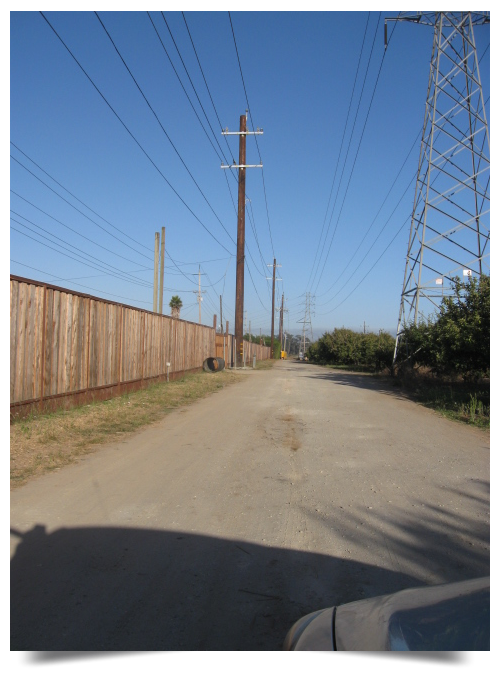
Several wooden poles along Minto Road were replaced with much larger ones. Because Minto Road is so narrow and the new poles so large, PG&E had to lower them in to the site via helicopter. Reportedly, PG&E also used drones to observe the work site.
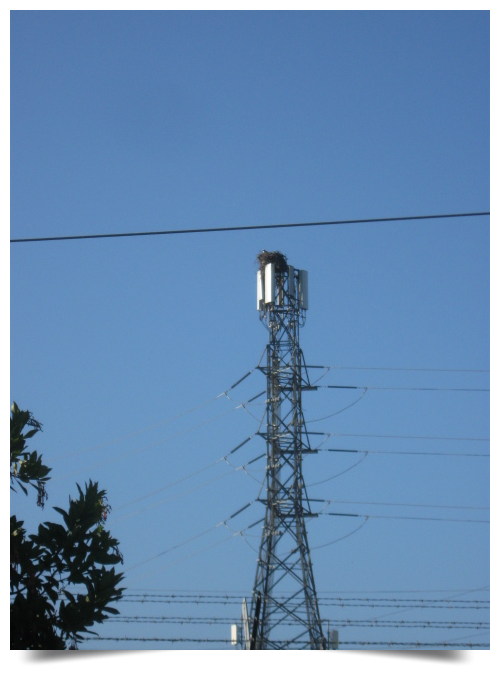
What about the active Osprey nest with three chicks located on top of the cell tower within the substation? Local residents were horrified to watch the frantic birds trying to protect the young in their nest as the drones and helicopters were buzzing about. Residents were extremely worried about the safety of the Ospreys.
The Osprey is fully protected under both the federal Migratory Bird Act and state laws Section 3503 and 3503.5 of the California Fish and Game Code.
The Osprey is listed as a “Species of Special Concern” and therefore merits close monitoring by CDFW.
Contact California Dept. of Wildlife Enforcement to ask if PG&E requested any biologists to observe the impacts of the intense aircraft activity on the active Osprey nest at the Green Valley Substation work last month? Will the Dept. of Wildlife monitor other Green Valley Substation upgrade work?
Santa Cruz area enforcement:
Wesley Stokes <wesley.stokes@wildlife.ca.gov>
Marilyn Culpepper <marilyn.culpepper@wildlife.ca.gov>
State Chief and Deputy Chief of Enforcement:
Nathaniel Arnold <nathaniel.arnold@wildlife.ca.gov>
Erica Manes <erica.manes@wildlife.ca.gov>
715 P Street, Sacramento, CA 95814
Mailing: P.O. Box 944209, Sacramento, CA 94244-2090
(916) 445-0411
Also, write to the Santa Cruz County Fish and Wildlife Advisory Commission and ask that they investigate the issue:
Sean Abbey<sean.abbey@santacruzcountyca.gov>
VISTRA HAS BEEN GHOSTING THE STATE WATER BOARD ON CLEAN UP COST AGREEMENT FOR MOSS LANDING BATTERY FIRE OVERSIGHT
The Central Coast Regional Water Quality Board sent Vistra a letter dated July 7, 2026, reminding that owner of the Moss 300 Battery Fire in Moss Landing that they had not yet responded to a request dated May 15, 2026 for agreement on a plan to reimburse the State for oversight work. The oversight would ensure Vistra is properly testing groundwater quality for contamination in the area of the fire and clean up work.
Vistra’s work plan includes installing 7 monitoring wells.
State Water Board staff will provide an estimated 200 hours of oversight work and bill Vistra for the time spent performing field and office work; site inspections; sampling; coordination with other agencies; meetings; case discussions; technical report and document review; regulatory review; correspondence preparation; closure reviews; and enforcement, as necessary. The cost is estimated at $49,000.
- Estimate of Work to be Performed Central Coast Water Board staff estimates that the following work will be performed during state fiscal year 2026/2027 (July 1 to June 30):
- Develop specific requirements addressing water quality issues.
- Conduct site inspection(s) to help determine status of various potential water quality issues.
- Attend meetings with discharger(s), their representatives, consultants and other interested parties.
- Conduct telephone communications with discharger(s) their representatives, consultants and other interested parties.
- Review and comment on technical reports such as work plans, monitoring reports, ground and surface water monitoring program proposals, site health and safety plan, site characterization and remedial action plan, remedial action reports, etc.
- Conduct agency internal communications such as memos, meetings, etc.
- Conduct site inspections and verification sampling.
- Develop specific requirements addressing water quality issues.
- Statement of Expected Outcome
The following are expected outcomes of work performed during state fiscal year 2026/2027:- Accurate physical and chemical characterization of water and sediment pollution sources and impacts, if appropriate.
- Adequate water quality monitoring, if needed.
- Commence remediation of water and sediment pollution sources and water and sediment pollution, as needed.
- Agency verification of the discharger’s data and conclusions.
- Compliance with agency requirements.
- Accurate physical and chemical characterization of water and sediment pollution sources and impacts, if appropriate.
However…
AGREEMENT
No cleanup oversight will be performed unless the responsible party of the property has
agreed in writing to reimburse the State for appropriate cleanup oversight costs. You
may wish to consult an attorney in this matter. As soon as the letter is received, the
account will be added to the active SCP Cost Recovery billing list and oversight work
will begin.
Luckily, Vistra representatives did sign the Agreement, on July 14, 2026, to reimburse the State Water Board staff for their work.
The State will also be expecting Vistra to comply with the conditions of approval of Vistra’s technical work plan for monitoring the groundwater in the area of the Moss 300 Battery Fire.
The Revised Work Plan proposes installing 7 groundwater monitoring wells to assess and monitor groundwater downgradient, cross-gradient, and upgradient of building ML 300. The Revised Work Plan proposes quarterly groundwater monitoring consistent with the minimum requirements specified in Order R3-2025-0030. The Revised Work Plan also proposes the submittal of data summary letters 30 days after receipt of analytical data reports and an annual groundwater monitoring report submitted after receipt of the fourth quarterly analytical data report.
CENTRAL COAST WATER BOARD COMMENTS
The Central Coast Water Board considers the Revised Work Plan complete with the following additions or revisions:
- The first quarterly data summary letter must be submitted by December 31, 2026, or 30 days after receipt of the analytical data reports, whichever comes first.
- The second quarterly data summary letter must be submitted by March 31, 2027, or 30 days after receipt of the analytical data reports, whichever comes first.
- The third quarterly data summary letter must be submitted by June 30, 2027, or 30 days after receipt of the analytical data reports, whichever comes first.
- The annual groundwater monitoring report must be submitted by September 30, 2027, or 30 days after receipt of the analytical data reports, whichever comes first.
The following constituents of concern (COCs) will be sampled during the second quarterly event, rather than the first, to reduce the influence of short-term drilling and well-installation disturbances.
- a. Dioxins and furans
- b. Polycyclic aromatic hydrocarbons (PAHs) and semi-volatile organic compounds (SVOCs)
- c. Per- and polyfluoroalkyl substances (PFAS) and adsorbable organic fluorine (AOF)
- d. Non-target analysis (NTA) assessment
- As a result of modifications made under Condition 5, discussions regarding potential reductions to the analytical suite, as specified in Section 4.4 of the Revised Work Plan, will take place after the second sampling event instead of the first.
Here is a link to the Water Board’s letter
You can watch for those reports and read other regulatory documents for the Vistra Moss Landing Battery and Electronic Fire on the GeoTracker website
GOING UP AND UP!
One cannot miss seeing the large new dormitories under construction at Cabrillo College while travelling along Highway One. When completed next year, this will provide housing for students from Cabrillo College (60%) and UCSC.(40%).
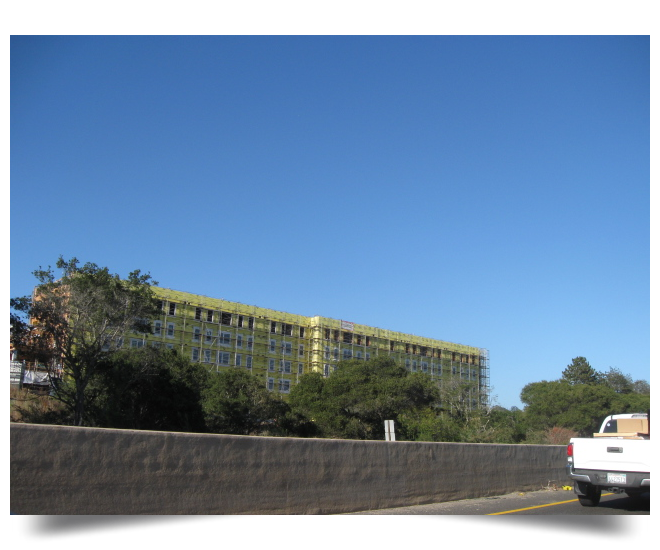
Hopefully, this will help students have affordable housing, and free up the housing supply to be available for others in the County and City of Santa Cruz. However, one does have to wonder about the traffic and water impacts of this mini-city…..
WRITE ONE LETTER. MAKE ONE CALL. ATTEND A PUBLIC MEETING AND ASK QUESTIONS.
DO ONE THING THIS WEEK AND MAKE A BIG DIFFERENCE.
Cheers,
Becky
Cheers,
Becky
|
Becky Steinbruner is a 30+ year resident of Aptos. She has fought for water, fire, emergency preparedness, and for road repair. She ran for Second District County Supervisor in 2016 on a shoestring and got nearly 20% of the votes. She ran again in 2020 on a slightly bigger shoestring and got 1/3 of the votes.
Email Becky at KI6TKB@yahoo.com |
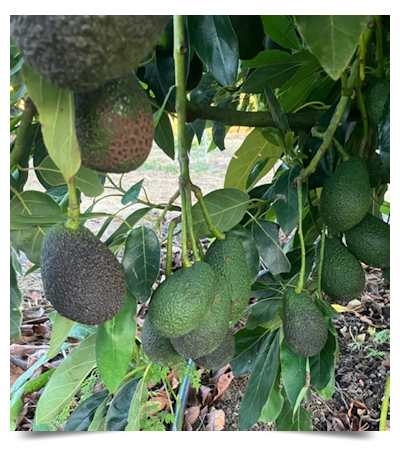
Avocado production on the Monterey Bay! |
The Monterey Bay region has a long history of farmers producing fruit, but that part of our landscape is changing rapidly. Economic fluctuation and climate change are playing important roles in influencing the fruit that comes from our lands. If we enjoy fruit and we want to rest comfortably that future generations can also enjoy the fruits of this land, it behooves us to better engage with these forces of change in case there are things we can do to help.
Crazy Diverse Fruit Possibilities
The diversity of fruit-growing possibilities for our area is astounding. There are so-called ‘banana belts’ that have long been frost free where one has long been able to grow crops you’d expect from the tropics. Cherimoya, banana, sapote, guava, passionfruit, maybe even lychee and a host of lesser-known tropical fruit are being produced in backyards and small plots, especially in a band 300-800 feet of elevation on the south-facing slopes of the northern Monterey Bay. Frost tender crops like avocadoes and citrus have been thriving for decades even at lower and higher elevations. And, because the winters are still mostly chilly, we have been able to grow more northerly crops like raspberries, strawberries, blueberries, cherries, grapes, pears, apples, peaches, and nectarines. The Monterey Rare Fruit Growers’ Association website has entries for hundreds of types of fruit with more being added regularly.
Fruity Economy
True farmers have long taken advantage of the area’s fruit growing potential. The Watsonville area’s apple growing is legendary, birthing the nationally-known Martinelli Apple Juice brand as well as diverse types of regionally-recognized fresh eating apples. Recently, apples have been slowly replaced by berries on any meaningful economic scale.
Strawberry farms occupy 35,000 acres in our region, but only a small percentage is farmed organically. Jim Cochran with his Swanton Berry Farm figured out that one could grow strawberries organically, and now there are several organic strawberry growers. “Conventional” strawberry producers, on the other hand, have been impacting our soil, air, and water with petroleum-based pesticides and plastics. Miles of plastic film is spread to keep strawberry farms weed free. Winter rains rush off the plastic-coated landscape, erode farm ‘ditches,’ and fill nearby creeks and wetlands with fertilizer and pesticide-enriched mud.
 Gala apples grown in the Monterey Bay area (ripe soon!) |
Acreage and economic value of raspberry and blackberry crops are about equal to strawberries in our region. Across larger and larger areas, Driscoll has long been innovating raspberry and blackberry farming in our area, growing and stretching their production into other countries and distributing them far and wide, year-round. To trick raspberries into producing for a longer season, raspberry growers have been installing hoop houses covered with plastic that can cover, or not, trellised rows of raspberries. That hoop house technology is also spreading into the hills of Central and South America.
Fruit Economics
The price of fruit drives the production of fruit. Agricultural lease rates are tied to how much the most profitable farms are willing to pay, and if you can’t raise the most lucrative crop, you can’t pay those high rents. Growing a lower-value crop, even for one season, is out of the question. Crop rotation, an ancient method of avoiding accumulating plant pathogens and pests, isn’t possible. So, pesticides ‘must’ be applied. Likewise, cover cropping for the winter to conserve and revitalize the soil is also ‘impossible.’ So, petroleum-derived fertilizers ‘must’ be applied. Raspberries and strawberries are the most lucrative fruit crops of our area and the most successful farmers (Driscoll!) are growing many acres of each, year round.
Apple Loss
Many readers will have already heard about the recently changes in fruit farming as Martinelli recently announced it is no longer willing to purchase apples from some of its large, traditional producers. Many acres of Newton Pippin and Mutsu (90% and 10% of their juice, respectively) apples that used to be grown locally to make that delicious cider may soon be chopped down. I’m betting that those acres of trees will be converted to berries (contracted to Driscoll farmers?) … or maybe housing!
It seems that profitably growing apples in the Monterey Bay area, even at large, ‘efficient’ scales, is no longer possible for the first time since the first orchardists planted shady groves of fragrant apples 170 years ago. My springtime tour of flowering apple trees near Corralitos will soon end.
Climate Change
The Earth is generally getting warmer and the weather is getting more extreme, but what does that mean for Monterey Bay fruit? I was stunned to discover in 2009 that Route One Farms had a sizeable Haas avocado orchard on a South-facing slope on Santa Cruz’s North Coast. Haas avocadoes can’t take frost, and that orchard was already mature! Since then, our farm – Molino Creek Farm {link} – has planted 100 avocado trees that are faring quite well, only occasionally slightly bothered by somewhat cold temperatures. We planted oranges, lemons, limes, and tangerines, too! One would have been considered quite foolish to plant large stands of these cold-intolerant species as recently as the 1990’s. And, we quite possibly might still see devastating results. The physics of freezing air is the same as it always has been- there is a continuous land mass between the Monterey Bay and the Arctic. Extremely cold air can still dip down our way and kill subtropical orchards, like in late 1990 and the first days of 1991 when long periods in the teens killed citrus across our region. Such weather fluctuations are to be expected with climate change, but drought, extreme heat and fire are probably the bigger concerns.
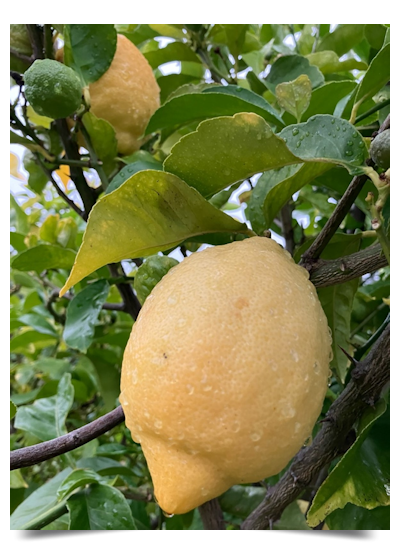 Locally grown citrus, fat and ripe, kissed by the bright, increasingly HOT Monterey Bay Sunshine |
Warm Winters, Heat Wave Summers
This past winter was extremely warm and recent summers have had terrible heat waves. Warmer winters do not accumulate the ‘chill hours’ northern fruit trees need to be productive. Each hour below 45F while a tree is dormant is one ‘chill hour.’ Apples, pears, cherries, peaches, and nectarines typically need 1200 chill hours. It starts getting that kind of cold in December and ends being that kind of cold in May, but there are warmer spells in there. We need 4 months of nights that stay below 45F for healthy northern fruit, but that is getting rarer with climate change.
Since 2008, our apple orchard has lost one third of its apples due to heat scorch from sudden heat waves. This has happened in August when the apples are large but not ripe and then there is a sudden heat wave lasting days with many hours reaching into the high 90s or low 100s, which we had not previously seen. The sun-exposed sides of the apples cook, turn brown, and then hundreds of fruit drop, littering the ground.
Climate change models suggest that our region will change to be more like Ventura County. Shall avocado and citrus groves replace apples?
Buy Local, Vote Global
Eating fresh, local fruit is healthy and smart. Voting for candidates with bold ideas to transition rapidly away from petroleum is also healthy and smart. Freshly picked, ripe fruit tastes divine and enjoying the many varieties of fruit can make you quite happy. Local farmers markets are the best places to arrive in fruity paradise, and locally owned grocers can also be a place to find such delight. It is the season of locally-produced bacon avocado and pluot, but you might not see these unless you seek them out and are lucky.
To fill the State and Federal government with representatives who are able to make climate-smart decisions, we need to raise those politicians locally. City Council candidates one day become County Supervisors then off to higher office. Each election is meaningful for the rapidity of change we need to maintain the fruit that makes for happy, healthy people.
|
Grey Hayes is a fervent speaker for all things wild, and his occupations have included land stewardship with UC Natural Reserves, large-scale monitoring and strategic planning with The Nature Conservancy, professional education with the Elkhorn Slough National Estuarine Research Reserve, and teaching undergraduates at UC Santa Cruz. Visit his website at: www.greyhayes.net
Email Grey at coastalprairie@aol.com |
Tuesday, July 14, 2026


Which image best tells us what Hermon (or Herman) Husband actually looked like? And who the heck is Hermon (or Herman) Husband, anyway? Wikipedia says Husband’s first name is spelled “Herman.” The New York Times Magazine, and author Woody Holton, says it’s “Hermon.”
Well, let me return to this more important question: Spelling issues aside, “who the heck is (or was) Hermon (or Herman) Husband?”
Though our Fourth of July holiday has passed, I am still reading and thinking about that 250th anniversary of the signing of The Declaration of Independence. July moves on, but I’m still stuck on July 4th. As someone who majored in American History in college, this only seems natural.
For those who weren’t aware of this, virtually the entirety of the July 5, 2026, issue of The New York Times Magazine was devoted to a series of articles that The Times called, “Visions of America.” I am making my way through that special edition of the magazine, and I am also still reading another special section of the July 5th edition of The Times that was focused on “six sentences that have shaped the American story.” Clicking those links I have provided should give you access, even if you’re not a subscriber to The New York Times. [And for those who aren’t, but who might like to read The Times, from time to time, let me remind you that anyone who possesses a Santa Cruz City-County library card – free to County residents – gets free online access to The New York Times].
As someone whose favorite book is titled, On Revolution, I like to think that I am pretty well-versed in the history of the American Revolution. However, until I read those “Visions of America” articles (seven articles, by seven leading historians, focused on little-known revolutionary leaders), I was not really aware of how little I actually did know. I commend the series to you!
Hermon Husband (I’ll use The Times’ spelling) is described by author Woody Holton and The Times as a “radical pacifist who inspired the first armed rebellion of the founding era.” I was most struck by Holton’s description of how Husband worked to make sure that actual power would be available to “ordinary Americans.” He was, in other words, someone who worked to provide the kind of real political power to ordinary people that would allow the nation actually to be governed by “we, the people,” not just by “the elites.”
In case you haven’t been reading the news, this is a real problem today. Elites of various kinds, from the billionaires on down, are actually the people who are “running the place.” In the United States of America, that is not the way it’s supposed to go. Hermon Husband knew that, right after the American Revolution disposed of British rule, and we’ve still got the same problem today. I identify with Hermon!
Read up. Maybe you’ll identify with Hermon, too.
|
Gary Patton is a former Santa Cruz County Supervisor (20 years) and an attorney for individuals and community groups on land use and environmental issues. The opinions expressed are Mr. Patton’s. You can read and subscribe to his daily blog at www.gapatton.net
Email Gary at gapatton@mac.com |
Dale is taking a break.
|
Dale Matlock, a Santa Cruz County resident since 1968, is the former owner of The Print Gallery, a screenprinting establishment. He is an adherent of The George Vermosky school of journalism, and a follower of too many news shows, newspapers, and political publications, and a some-time resident of Moloka’i, Hawaii, U.S.A., serving on the Board of Directors of Kepuhi Beach Resort. Email: cornerspot14@yahoo.com. |
Each week, I will feature a selection of interesting and historically significant places in Santa Cruz County from the 1986 edition of Donald Thomas Clark‘s wonderful book, “Santa Cruz County Place Names: A Geographical Dictionary“, published by the Santa Cruz Historical Trust.
“Nuggets” If I find something topically relevant, but not necessarily directly related to the week’s selection, you’ll see it under the Nuggets heading. Note: for reasons of brevity, sources are usually dropped when I reproduce an entry. You can always email me if you’re curious, or, even better, buy a copy of the book!
Dateline: July 15, 2026
“Winkles Bridge” is an excellent example of how geography, and what I call “small history”, the history of people who lived extraordinary lives (his travels alone, migrating from Germany to New Orleans to St. Louis to California, are fascinating to think about), but were not “great men (and occasionally women) of history”, even just locally. Mr. Winkle was obviously prominent enough to merit an entry in J.M. Quinn’s 1903 history / “biographical record”, but it doesn’t seem that he occupied any official position of power or authority, though he was a member of the “Santa Cruz Society of California Pioneers” (along with his wife, Lucie nee. Junsen), according to the Santa Cruz History Wiki page on him.
Completely undocumented in the Santa Cruz History Wiki, I found a fascinating little family saga when a search revealed an entry for his step-son, Leonard Cornelius Winkle. Leonard “legally changed his surname from Fischer to Winkle in 1900”. That site reveals that his wife’s full name was Anna Marie Lucie Jensen Winkle (also born in Germany), and that she was previously married to one George A. Fisher, who died in 1872 (with whom she had three sons), a year before she married Henry in 1873, according to Find A Grave. According to the entry for “George Henry Winkle”, all there brothers took Henry’s last name (as adults) after being raised by him. One would presume that this is an indication of Henry’s parental character.
The entry for Henry himself includes an obituary in the Santa Cruz Sentinel, which states “The funeral of the late Henry Winkle took place Friday under the auspices of the Masons. Interment was in the Soquel cemetery.” Only a Mason is honored this way, so that’s another indicator of social status. Further, and this is a really interesting example of family dynamics, according to the site, Henry had a first wife, Fredericka Hagemann Winkle, who may very well have died in childbirth (as there is an baby grave adjacent to her plot). Now, the fascinating part: Henry and Lucie had one child, Fredricka Anna “Freda”Winkle Salmonson (born in 1876, died in 1941), and she is are buried in the same lot (according to find a grave) as her (presumed) namesake. It’s something to name your first child / first daughter after your deceased ex-wife!
A quick search reveals that there is a “Winkle Ave” in Soquel, along with a Winkle Farm County Park on that same street (just off Soquel Avenue near Dominican), which seem likely to be related. A glance at a property records site shows that the oldest residences were built in 1925 (1) and 1930 (2), with further batches being built in the 1940s and 1960s and 1980s, which suggests a pattern of development after the original owners passed on.
At a guess, a deeper dig into county records might yield some information of how “Winkle Farm” became “Winkle Farm County Park” and where Winkle Ave. got its name. All this from a casual, “Winkles Bridge, that sounds interesting” when flipping through the Place Names book!
A bridge that crossed Rodeo Creek along what is now known as Soquel Drive. It existed at least some time before 1888 when the following notice appeared in the Santa Cruz Surf, June 2, 1888:

…a subscription is being circulated to raise funds to defray the expenses of sprinkling Soquel Road from the covered bridge at Santa Cruz to Winkle’s bridge near Soquel.Named for a land owner. Hatch’s county map of 1889 shows lands in Section 9, T11S, R1W, bordering both the road and the creek which were owned by one H. W. Inkel, obviously a mistake for H. Winkel. On the south side of the road the map shows property of Winkel. H. Winkel is listed in the roster of members of the Santa Cruz Society of California Pioneers as a native of Germany born February 22, 1822, who arrived in California in September 1850. His name is given as Henry Winkle in Guinn (1903, p.636) where the author writes:
Landing in New Orleans, Mr. Winkle subsequently went to St. Louis, where he lived for four years, and during the latter part of that time was disturbed by the rumors of gold that came from ship passengers and overland travelers. He therefore joined a caravan bound for the great plains, and upon arriving at this destination on the coast, located at Placerville, where for seventeen years he tempted fate in the surrounding mines. He experienced the average number of disappointments and failures, but he was successful to the extent that he was able to purchase his present ranch of two hundred acres upon his removal to Santa Cruz] county in 1866.
He is listed as Henry Wenkle, farmer from Prussia, Soquel, in The Great Register of Santa Cruz County, 1867. He became a naturalized citizen on August 14, 1867. The Soquel Cemetery records show the name as Henry Winkle, died February 20, 1903, aged 81.


|
Thomas Leavitt is the husbandy thing to our illustrious webmistress. A resident of Santa Cruz (now part time) since 1993, his interests include history, technology, and community organizing. He started the world’s first self-service web hosting company, WebCom, located at 903 Pacific in May of 1994. He’s been part of too many community organizations to mention, and ran for City Council in the early aughts. Email Thomas at ThomLeavitt@gmail.com |
 “Commitment”
“Commitment is an act, not a word.”
~Jean-Paul Sartre
“Unless commitment is made, there are only promises and hopes… but no plans.”
~Peter Drucker
“Most people fail not because of a lack of desire but because of a lack of commitment.”
~Vince Lombardi
“Commitment is what transforms a promise into reality.”
~Abraham Lincoln
“There’s a difference between interest and commitment. When you’re interested, you do what’s convenient. When you’re committed, you do whatever it takes.”
~Ken Blanchard
|
Battle over Charles Manson’s corpse? Take it away, Caitlin! |
Direct questions and comments to webmistress@BrattonOnline.com
(Gunilla Leavitt)